
Scoliosis disrupts the spine’s straight alignment, and because a primary role of the spine is to facilitate healthy posture, asymmetrical posture is the earliest sign of scoliosis in children; uneven shoulders and hips are what to watch for.
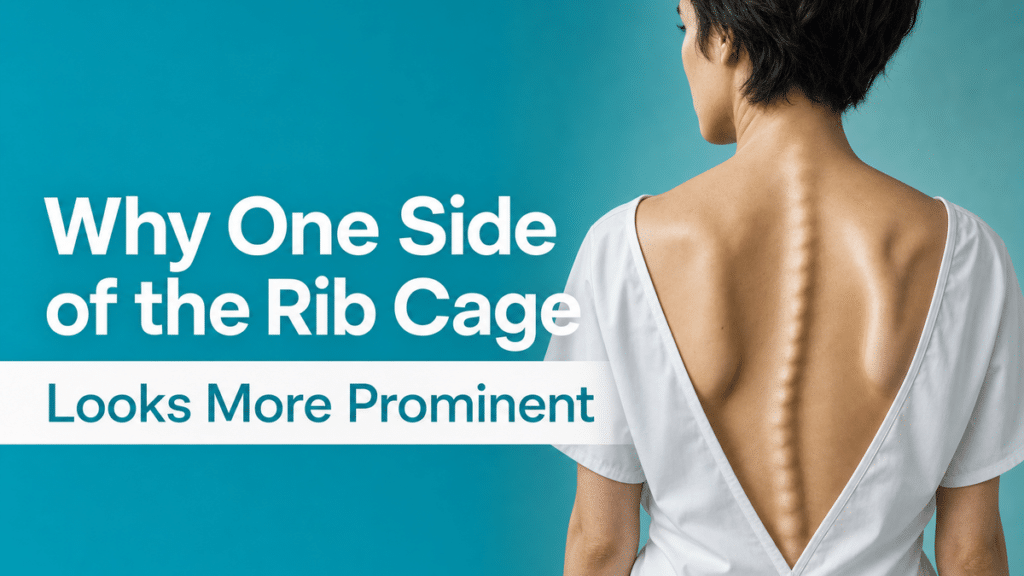
As an asymmetrical spinal condition, a primary effect of scoliosis is the development of a rib hump. Also known as rib flaring, when the spine’s unnatural curve and rotation pulls on one side of the rib cage, one side will protrude more.
Although scoliosis is a spinal condition, its effects aren’t limited to the spine alone.
Scoliosis and Posture
Scoliosis causes an unnatural lateral spinal curve with a rotational component, so scoliosis is a complex 3-dimensional spinal condition.
There are a number of spinal conditions that cause a loss of healthy spinal curves, and the rotational component sets scoliosis apart, along with its progressive nature.
Scoliosis is also a progressive condition, so it’s likely to get worse over time, and in children, it’s growth that triggers progression. In adults, incremental progression can occur over time, and in older adults, if degenerative changes to spinal health are occurring, progression can increase up to 4 degrees a year.
Postural asymmetries will increase alongside progression as the scoliosis is becoming more severe.
Scoliosis can range widely in severity from mild scoliosis to moderate, severe, and very severe scoliosis.
As scoliosis progresses, the asymmetrical forces exposed to the spine and body are increasing, so the effects become more overt and disruptive. In some cases of mild scoliosis with subtle symptoms, they are difficult to detect.
The spine’s main roles are to support healthy posture, movement, protect the spinal cord and important organs within the thoracic cage, and to act as the body’s central structural anchor and an attachment point for muscles, ligaments, and supportive structures.
The spine’s healthy curves work together to maintain the spine’s balance and stability, and if an unhealthy curve develops, the body’s balance and stability are disrupted.
So if the spine curves sideways and rotates, the first noticeable effects are postural asymmetries.
Scoliosis Rib Hump
There are different types of scoliosis, severity levels, and spinal sections to be affected. The main spinal sections include the cervical spine (neck), thoracic spine (middle/upper back), and the lumbar spine (lower back).
Each section has primary roles to play in maintaining the spine’s overall health and biomechanics, and while scoliosis affects the health of the entire spine, the section it develops in is the main area affected, along with the section’s immediate surroundings.
When it comes to a rib hump, this is most closely associated with thoracic scoliosis. The thoracic spine is the only section that attaches to the rib cage, and together with the sternum, the thoracic spine and the rib cage form the thoracic cage.
The thoracic cage protects the heart, lungs, and important digestive organs, and because the thoracic spine attaches to the rib cage, if the spine is curving unnaturally to the side and rotating, it can pull on the rib cage, disrupting its alignment, and causing one side to protrude excessively.
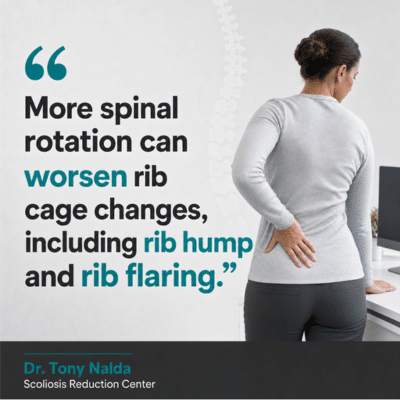
The more axial rotation there is in the spine, the more the rib cage will be affected, and if scoliosis is left untreated, a rib hump, along with additional effects, can worsen over time, and rib flaring can have a number of effects.
Rib Flare Effects
A noticeable arch in the rib cage isn’t just visual; it can cause functional deficits.
A rib flare also contributes to further postural changes by shifting the body’s center of gravity, disrupting shoulder and waistline symmetry.
Chest and rib pain is a common effect as the asymmetrical position of the ribs cause uneven pressure on the joints connecting the spine to the sternum.
When growth stops, scoliosis becomes a compressive condition, and in cases with severe rotation, nerve compression is common and can cause radiating pain in the extremities.
Muscle pain is also common as the muscles surrounding the spine and rib cage are struggling to counteract the asymmetrical position of the spine and rib cage. Muscles can become tight, sore, unbalanced, and muscle spasms may develop.
A weak core can also develop due to biomechanical rib cage dysfunction interrupting the alignment and stability of the pelvis.
Rib Arch Complications
In severe cases that are left untreated, a severe rib hump can cause complications such as lung impairment, cardiac and digestive issues.
While lung impairment isn’t considered a primary symptom of scoliosis, when severe and/or if left untreated, severe vertebral rotation with a large rib hump can cause a loss of space within the chest cavity for the lungs to function within.
If the lungs are being compressed, their ability to fully expand can be disrupted, causing shortness of breath and shallow breathing.
In most cases of scoliosis lung impairment, however, the changes are not always noticeable and are most likely noticed by individuals placing higher-than-average demands on their respiratory systems (professional athletes and runners).
If the lungs are affected, due to their close proximity to the heart, the lungs can press into the heart, causing less space and interrupting the heart’s ability to beat efficiently and transport blood throughout the body.
Digestive issues can also develop due to compression of digestive organs and/or interruptions in brain-body communication that supports the digestive process.
When it comes to a rib arch and noticeable postural changes, this can also affect body image and mental health, particularly in adolescents who are vulnerable to self-esteem issues.
Rib Hump Treatment Options
Rib humps are a common effect of scoliosis, and the best way to minimize the potential postural changes caused by scoliosis is to treat the scoliosis proactively.
Spinal alignment shapes body posture and the position of the rib cage, and if an unnatural spinal curve develops, the structural nature of the curve needs to be addressed.
A scoliosis patient needs to make an informed decision regarding the type of treatment approach to commit to.
Scoliosis can be treated with surgery or nonsurgically, and nonsurgical scoliosis treatment is proactive, noninvasive, and has proven results.
Scoliosis surgery is a type of spinal fusion, and like all spinal surgeries, comes with significant risks and potential complications. The main reason most scoliosi patients opt for surgical intervention is cosmetic reasons, but the reality is that spinal fusion focuses solely on the spine, not its effects.
Many patients are disappointed that while their spine is straighter, a rib hump and uneven hips can remain. It’s not uncommon for spinal fusion to be followed by an osteotomy: another invasive surgery that focuses on restoring the rib cage’s alignment by cutting, reshaping, and realigning the rib cage.
Nonsurgical scoliosis treatment focuses on improving the spine’s position and alignment, but also on improving the body’s 3-dimensional posture.
In addition, because nonsurgical treatment is proactive and starts immediately following a diagnosis, the ultimate goal is preventing progression and increasing effects, including a prominent rib cage arch.
Non Surgical Treatment Options
Here at the Scoliosis Reduction Center®, nonsurgical treatment is integrative; it combines the potential of multiple scoliosis-specific treatment disciplines so the spine’s position, and its surroundings, can be improved.
Chiropractic BioPhysics® is specialized scoliosis-specific chiropractic care that can include a number of techniques and manual adjustments that target the position of the curve’s most unnaturally-titled vertebrae: improving spinal alignment.
As we know it’s not just the spine that maintains its healthy curves and alignment, but also the work of strong core and back muscles, scoliosis-specific physical therapy and targeted scoliosis-specific exercise is applied to improve core and back muscle strength and balance.
A large focus of scoliosis-specific physical therapy is postural awareness and restoration. Improvements to the body’s 3-dimensional posture is key to improving a rib hump.
With more support and stability for the spine and rib cage, postural symmetry can be improved, and corrective bracing, used in conjunction with scoliosis-specific rehabilitative exercise plans and CBP®, can further improve the spine’s position, stability, and retrains the brain and body’s connection to support healthy posture and the spine’s healthier position.
Conclusion
When it comes to rib prominence and scoliosis, uneven shoulders, shoulder blades, uneven hips, and an asymmetrical rib cage are common effects.
As scoliosis develops and progresses, it’s introducing uneven pressure to the spine, its surrounding muscles and supportive structures, and the entire body.
A misaligned spine can cause a misaligned body, and the effects of asymmetric loading and wear can trigger the onset of degenerative changes in the spine that are difficult to reverse, but when a spinal misalignment is addressed proactively, improvements can be made and progression may be prevented.
It’s never too late to start scoliosis treatment, but when it comes to postural changes such as a rib hump, the earlier it’s started, the better.
When mild, curves are small and flexible, making it simpler to improve the spine’s position and restore its healthy curves, but as scoliosis progresses and the spine’s unnatural curve and rotation increase, the postural changes become more overt and established, and the longer they’re in place, the harder they are to improve.
So the best way to address a scoliosis rib hump is through proactive treatment that works towards preventing progression and increasing asymmetrical postural changes.