

For parents supporting a child through a recent scoliosis diagnosis, it’s important to understand the progressive nature of scoliosis, particularly during rapid growth stages, and the importance of treatment. The day following a diagnosis may be overwhelming for children and their families, but important decisions also need to be made during this time.
After a child is diagnosed with scoliosis, parents should ask questions to make sure the diagnosis is clearly understood. Discussing curve severity, how much rotation there is, and a particular patient’s risk of curve progression are important factors. After a child’s curve, progression risk, and suitable treatment options are considered, it’s time to start treatment.
A scoliosis diagnosis starts with a comprehensive assessment that looks for signs of scoliosis and confirms the presence of the spine’s unnatural lateral curve and rotation with an X-ray.
Diagnosing Childhood Scoliosis
Diagnosing childhood scoliosis isn’t always easy. In some cases of mild curves, the warning signs can be subtle and difficult to notice, but as an informed parent who knows the early signs to watch for, you can set your child on the path of early detection and intervention.
The earliest signs of childhood scoliosis to watch for are postural changes. Uneven posture such as uneven shoulders, one shoulder blade sticking out more, one hip sitting higher, an asymmetrical rib cage, and clothing that starts to fit unevenly are common signs.
If signs of scoliosis are noticed, a professional assessment should be scheduled as soon as possible because as a progressive condition, the timing of treatment can be an outcome-shaping factor.
Although treatment results can never be guaranteed, children have a lot of potential gains from diagnosing and treating scoliosis proactively during growth, rather than after growth spurts have caused significant progression.
Scoliosis can increase as a child grows, and the larger a scoliosis curve is at the time of diagnosis, the more likely it is to continue progressing, so the goal is to diagnose and treat a child’s scoliosis early. And it’s important to be aware that even curves diagnosed as mild can progress and change quickly during growth.
So if you’ve taken a child to a medical professional to be screened for scoliosis, and the examination identified risk factors, an X-ray is usually the next step to confirm the spine’s lateral curvature, rotation, and to fully assess the child’s curve and situation.
Asking Questions After a Scoliosis Assessment
One of the best ways to support a child through a scoliosis diagnosis is to ask questions, be informed, and make sure the results of the spine assessment are clearly discussed.
Parents who fully understand their child’s curve and situation can address their child’s questions accurately and make informed treatment choices.
Treatment recommendations are based on a number of complex patient and curve characteristics.
Understanding Curve Severity: How Bad is My Child’s Scoliosis?
Part of a child’s spine assessment involves determining the size of a scoliosis curve with a measurement known as Cobb angle, and it needs to be measured accurately. Patients and families need to understand this term because treatment recommendations are based on severity and it will likely be referred to repeatedly during monitoring and treatment.
Scoliosis curves can range from mild to moderate, severe and very severe, and a patient’s Cobb angle is determined by drawing lines from the tops and bottoms of the curve’s most-tilted vertebrae. The resulting angle is expressed in degrees, and the higher a patient’s Cobb angle, the more severe the scoliosis.
What parents and children need to fully understand, however, is if a curve is progressing, the Cobb angle can change quickly, also increasing the urgency of treatment because if a certain severity level is reached, surgical treatment (spinal fusion) may be recommended.
Curve severity is determined mainly by size, but severity is also tied to progression. A larger curve that’s not progressive may be easier to address than a curve that starts out small but is progressing rapidly, and curve location and how much the curve’s vertebrae rotate (twist) can also affect how a curve changes over time and growth.
Thoracic curves, for example, are associated with more rotation because the thoracic spine attaches to the rib cage, and as the largest spinal section and the most commonly affected, thoracic curves are usually assessed at an increased progression risk.
In addition to curve severity, progression risk is a term that needs to be fully understood to support children and make informed treatment choices, so asking questions about if, how much, and how fast, a child’s curve is predicted is important for preparing a child and family for the changing nature of some scoliosis curves.
Understanding Progression Risk: How Much Worse Can My Child’s Scoliosis Get?
The most important thing about scoliosis for patients and families to recognize is its changing nature. There are a number of factors that can drive curve progression, but when it comes to children, growth mainly triggers a curve to increase.
Part of a thorough scoliosis assessment and diagnosis will include predicting a patient’s progression risk, and in addition to curve size and location, a child’s growth potential and bone age needs to be determined.
Adolescent Idiopathic Scoliosis
The most common type of childhood scoliosis is adolescent idiopathic scoliosis, and this age group is usually the most at risk for rapid progression due to the unpredictable growth spurts of puberty.
Because two children of the same age can grow at different rates and reach different heights, bone age becomes more important than chronological age when it comes to accurately predicting how much worse a child’s scoliosis may become.
Very young children have more remaining growth potential so may face more overall progression over time, but adolescents are usually more at risk for rapid-phase progression occurring over a shorter period of time due to the peak velocity growth spurts of puberty.
How much growth a child has left before reaching skeletal maturity is key because once the spine stops growing, it becomes more rigid and its position and alignment is more fixed and difficult to improve.
So diagnosing a child’s scoliosis early and treating it proactively during growth, rather than after, gives us the opportunity to impact the curve while the spine is still growing and its flexibility supports correction.
There is a critical period for addressing a child’s scoliosis. The chance to treat a child’s spinal curve when it’s most likely to respond well won’t always be there, and recognizing the opportunity supports treatment efficacy for positive outcomes.
Understanding Treatment Recommendations: How Do We Treat My Child’s Scoliosis?
A child’s spine and scoliosis needs to be comprehensively assessed, and we’ve discussed some of the important details that are considered including curve severity, location, and progression risk.
Parents hearing assessment results should have a lot of questions, but one of the first concerns I hear involves treatment: what can be done and when should it start?
While some childhood curves are assessed as stable, most are progressive due to growth, and treatment options are shaped around the goal of counteracting progression during growth so the spine’s position and alignment can be improved and supported.
In some cases of early onset scoliosis in younger children with small flexible curves that are diagnosed early, corrective bracing may be considered a suitable treatment option, and in cases of larger progressive curves, corrective bracing may be combined with a customized scoliosis-specific exercise program (physical therapy) and scoliosis-specific chiropractic care.
Scoliosis curves need to be impacted on multiple levels, and treatment options shouldn’t just focus on the spine, but also on improving the spine’s surroundings. A child’s scoliosis curve can be fed by a number of factors including a lack of support from the spine’s surrounding muscles, so while bracing maintains the spine and torso’s straight alignment, in appropriate cases, a scoliosis-specific exercise plan can target muscle strength and balance for more stability for the spine.
Scoliosis-specific chiropractic care (Chiropractic BioPhysics®) applies a scientific evidence-based approach to improving the spine’s position through a series of techniques and manual adjustments for appropriate patients.
When powerful treatment modalities are combined, they can complement one another and work towards the common goal of curve correction.
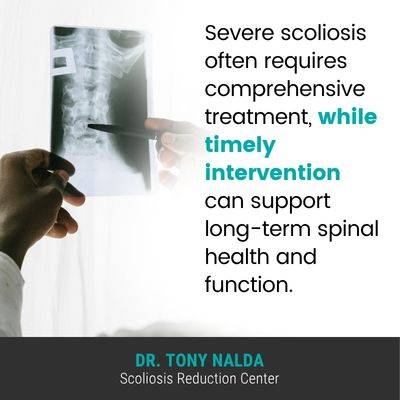
Curves assessed as severe with a high progression risk usually need broad treatment plans to manage the curve, and in many cases, timely assessment and intervention supports proactive curve management for long-term spinal health and function.
Conclusion
So for parents wondering what they should do after their child is diagnosed with scoliosis, taking time to process and understand the diagnosis is important, but we also don’t want to miss a critical treatment period.
Parents shouldn’t be afraid to ask questions following an assessment because there will be a lot of complex medical terms and concepts to discuss and understand, and when it comes to advocating for a child, being informed means you can answer your child’s questions accurately and honestly.
Understanding a child’s curve and progression risk also supports making informed treatment choices, and recognizing the early signs of childhood scoliosis for a timely assessment and diagnosis gives us the chance to manage curves during growth when there may be more potential to correct the curve.
Here at the Scoliosis Reduction Center®, we collaborate with clinicians, patients, and parents to come up with a personalised care plan that supports a child’s emotional and physical treatment needs.