

Part of managing scoliosis effectively involves factoring a patient’s potential progression risk into the customization of treatment plans. Scoliosis progresses the most during periods of rapid growth, degenerative instability, and when severe and/or left untreated.
Childhood scoliosis progression is triggered by growth spurts; in adults, progression can slow due to skeletal maturity, but if/when degenerative changes to spinal health develop, degenerative scoliosis can also progress rapidly. Scoliosis progresses the most when it’s severe.
Scoliosis is a complex spinal condition that ranges widely in severity and requires a proactive treatment approach.
Understanding Progression
Scoliosis is a progressive spinal condition that causes the spine to curve unnaturally to the side and rotate, and if progression is occurring, the spine’s unhealthy lateral curve and twist is getting worse.
As scoliosis is progressing, the spine is becoming increasingly rigid, and this can make it less responsive to treatment, and in adults is a source of pain.
If scoliosis is progressing from mild scoliosis to moderate, severe, or very severe scoliosis, its effects are also becoming more noticeable and disruptive.
There are no treatment outcomes that can be guaranteed, but there are significant benefits associated with early detection and intervention.
The goal is to diagnose scoliosis while mild so treatment can be started while curves are small, flexible, responsive, and before condition effects become established.
Scoliosis isn’t always easy to diagnose; especially in cases of mild childhood scoliosis, effects can be subtle and difficult to recognize. In most cases, it’s uneven shoulders and hips that are the earliest indicators of scoliosis, and in adults, it’s most often pain that leads to assessment, diagnosis, and treatment.
So when does scoliosis progress the most? The main trigger for scoliosis progression is growth.
Growth and Progression Risk
Skeletal growth is the main trigger for progression, so children are the most at risk for potential progression because they have not yet reached skeletal maturity.
Part of a child’s assessment and diagnosis involves determining their bone age so treatment plans can be shaped around how much progression is expected, and at what rate.
A patient’s Risser sign assigns a level of bone maturity to the pelvis to help predict a patient’s progression risk, and additional factors shape a patient’s rate of progression such as the type of scoliosis, and curve location.
The most prevalent form of scoliosis overall is adolescent idiopathic scoliosis diagnosed around the onset of puberty, and this age group is the most at risk for rapid-phase progression due to the unpredictable nature of pubescent growth spurts.
Atypical types of scoliosis, such as neuromuscular scoliosis, can progress rapidly because there is a larger condition causing the scoliosis as a related complication, and in these cases, the larger neuromuscular condition is the focus of treatment.
Scoliosis can develop anywhere in the spine, but thoracic scoliosis is the most closely associated with quick progression, and this is likely due to the thoracic spine’s attachment to the rib cage.
Interestingly enough, while scoliosis is largely considered a childhood condition and most often occurs during adolescence, the actual rate of scoliosis increases in the aging population due to degenerative scoliosis.
Degeneration and Progression Risk
Growth triggers progression in children, and changes to spinal health can trigger progression in adults.
As we age, muscles and libaments tend to stretch and weaken, contributing to a lack of spinal support and stability, and poor posture can also develop over time and cumulatively shapes the spine’s long-term health.
While some age-related changes may be inevitable, it’s important for people to understand the cumulative effect that certain lifestyle factors can have on the spine’s health and function.
Carrying excess weight strains the spine, its discs, and its facet joints, and also contributes to poor posture and weak core/abdominal muscles.
A low activity level is bad for core and back strength, spinal flexibility, weight, posture, and disc health, and over time, can contribute to a weak and unstable spine.
As we age, postural collapse is common, and a prominent lean to one side or too far forward introduces uneven forces to the spine, its discs and facet joints, and its surrounding muscles and supportive structures; if left untreated, over time, initiates a damaging cycle of asymmetric posture, weight distribution, and degeneration.
When the spine degenerates unevenly, it’s becoming increasingly unbalanced and unstable, putting older adults at risk of injury through a fall.
When the spine is unstable, it’s vulnerable, and a progressive condition will only continue to get worse if left untreated.
Severity and Progression
Scoliosis severity is determined largely by a patient’s Cobb angle measurement, and it’s imperative that it’s measured accurately; the measurement is monitored as an indicator of treatment efficacy and how the spine is responding to growth.
Scoliosis can range from mild to moderate, severe and very severe, and the more severe scoliosis becomes, the more likely it is to continue progressing. Once the spine is misaligned, it requires treatment to correct the structural abnormality, or the disruption in its balance and biomechanics will only increase over time.
The goal of a proactive Nonsurgical treatment approach is to diagnose scoliosis while mild so treatment can be started with the potential to prevent further progression.
Once scoliosis progresses past the surgical threshold, nonsurgical treatment options are more limited, and while spinal fusion surgery has become a common procedure, it’s still an invasive spinal surgery that can make the spine weaker, more vulnerable to injury, and less flexible.
Scoliosis, however, can be highly treatable, particularly in the early stages.
Progression makes scoliosis more complex to treat, and while some mild curves may stabilize and not progress, the more severe a patient’s scoliosis at the time of diagnosis also indicates potential curve progression.
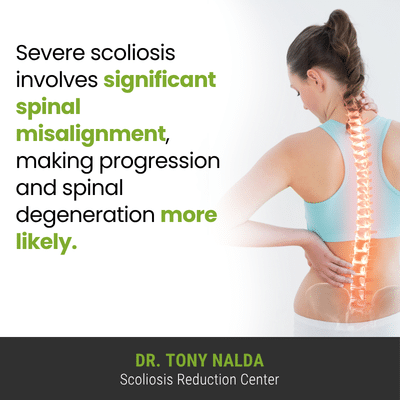
Scoliosis that’s diagnosed as severe is well-established, progression has occurred, and the spine’s misalignment is significant, meaning its effects are likely to be overt and disruptive; the more severe scoliosis becomes, the more out of balance the spine is, and the more vulnerable it is to further progression and degenerative changes to spinal health.
Counteracting Progression with Treatment
As a progressive condition, the nature of scoliosis is to get worse over time. While some cases of early-onset childhood scoliosis can resolve on their own or stabilize, most children and adults diagnosed with scoliosis will experience progression.
The only way to counteract the progressive nature of scoliosis during periods of rapid growth or degenerative instability is through a proactive treatment plan that impacts scoliosis on multiple levels.
Here at the Scoliosis Reduction Center®, patients benefit from a comprehensive initial assessment and the customization of proactive nonsurgical treatment plans.
Treatment needs are case-specific, but for small flexible curves diagnosed and treated early, a scoliosis-specific exercise plan may help, and in cases of more rigid larger curves, a common treatment recommendation combines scoliosis-specific exercise, corrective bracing, and scoliosis-specific chiropractic care.
Scoliosis-specific exercise teaches postural awareness and improves the spine’s surrounding muscles strength and balance for optimal spinal support and pain relief. Corrective bracing complements scoliosis-specific exercise by maintaining the torso and spine’s upright and neutral position and strengthening the connection between the brain and the body’s new posture.
Scoliosis-specific chiropractic care targets the most unnaturally-positioned vertebrae and aims for structural improvement.
Together, these treatment modalities are working towards a common goal: improving the spine’s alignment, body posture, and counteracting progression.
Conclusion
Cases of scoliosis range widely in severity and treatment needs. As a progressive condition, the sooner treatment is started, the better.
Scoliosis progresses the most during periods of rapid growth, making adolescent idiopathic scoliosis the most prevalent type.
Scoliosis can also progress rapidly during degenerative changes to spinal health, which is why the actual rate of scoliosis increases among older adults.
Adolescent idiopathic scoliosis can progress rapidly due to unpredictable growth spurts, and degenerative scoliosis that develops later in life can progress quickly due to increasing degenerative instability.
Scoliosis progression isn’t guaranteed, but the more severe scoliosis is at the time of diagnosis, and/or becomes, the less likely it is to stabilize.
Scoliosis patients will likely notice progression through increasing symptoms such as more overt postural changes (uneven shoulders, shoulder blades, hips, rib flaring) and increasing pain, including radiating pain in the extremities.
Changes to balance, coordination, gait, and proprioception are also common.
If scoliosis effects are increasing, it’s becoming more severe and complex to treat, and is a sign that treatment is becoming more urgent; don’t hesitate to reach out for assessment and guidance.