
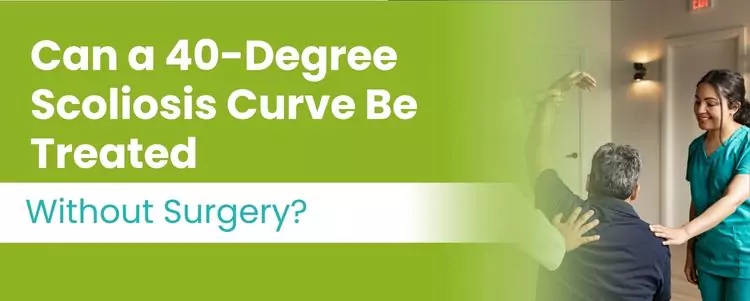
There are a number of factors considered in scoliosis treatment planning, and when proactive nonsurgical treatment supports improvement and/or correction, some severe scoliosis patients may avoid progression and the need for surgical treatment.
A scoliosis curve is measured in degrees, and while a 40-degree curve is considered severe and sits at the surgical threshold in some cases, curve size isn’t the only factor treatment recommendations are based on. Patient age, risk of curve progression, curve flexibility, and symptoms also matter, making each case unique and necessitating the customization of treatment plans.
While there are no treatment guarantees, in some cases, conservative scoliosis treatment may support 40-degree curve improvement.
Curve Severity
Not all 40-degree scoliosis curves require surgery, but individual assessment is needed to predict which severe curves are likely to respond to scoliosis-specific bracing, physical therapy, and chiropractic care, and which are too severe and progressive and may need surgical treatment.
Scoliosis causes the spine to curve unnaturally to the side and rotate, and while a scoliosis assessment includes determining the size of the curve, it also considers other important factors.
Curve severity helps predict curve progression because most large curves are progressive. The larger the scoliosis, the more off-balance the spine is, and the more likely it is that treatment recommendations may include surgery.
However, when scoliosis is diagnosed and treated early, in many cases, it’s highly treatable, and a proactive approach works towards preventing progression, rather than responding to it. Traditional treatment recommendations included a lot more watching and waiting than a modern proactive response.
Here at the Scoliosis Reduction Center®, we’re passionate about education and awareness because this is what helps patients directly – it helps the early signs of scoliosis get noticed, helps them get diagnosed earlier, and treatment starts sooner.
So regular assessment for children with a family history is recommended, and adults experiencing lower back pain and changes to posture and stability should be regularly assessed for degenerative changes to spinal health and function.
Curves can range from mild to moderate, severe, and very severe, and curve size is determined by a measurement known as Cobb angle.
How is Curve Degree Determined?
An X-ray is needed to diagnose scoliosis. It confirms the spine’s unnatural curve, rotation, and measures curve size. A minimum curve size of 10 degrees is necessary to be considered a true scoliosis, and a patient’s Cobb angle determines curve size and severity.
Measuring a patient’s Cobb angle involves drawing lines from the tops and bottoms of the curve’s most-tilted vertebrae, and where the lines intersect, an angle is formed that’s expressed in degrees. The higher a patient’s Cobb angle, the larger the curve.
Mild scoliosis describes curves of less than 25 degrees, and curves of between 25 and 40 are considered moderate, while 40+ curves can be classified as severe.
Large curves are more prone to progression. If the spine develops an unhealthy curve, its overall balance is disrupted, and the larger the curve, the larger the disruption, and the more unstable the spine may become.
In most cases, it’s when curves progress into the severe classification that treatment considerations start to include surgery, but remember, there is a lot that can be done before a curve reaches the severe level.
Proactive nonsurgical treatment can include scoliosis bracing, scoliosis-specific physical therapy, and/or scoliosis-specific chiropractic care, and in some cases, starting these treatments early may support enough improvement to the spine’s position and balance to prevent progression effectively.
Severe Scoliosis Treatment Recommendations
A patient’s curve size needs to be measured accurately because the initial Cobb angle measurement is used as a baseline to compare how the spine is responding to treatment and/or other factors that contribute to progression such as growth or changing spinal health.
If a patient’s severe curve is staying the same through growth and time, monitoring may be recommended; if it’s increasing, progression is happening and treatment is needed and/or may need to be adjusted, and if the angle is decreasing during treatment, corrective results may be within reach, but each case is unique, particularly when it comes to variables such as patient age.
Because curve severity is a primary treatment planning factor and a 40-degree curve is considered severe, some patients with severe scoliosis will receive a surgical recommendation, but that doesn’t mean it’s the only choice available, and in some cases, nonsurgical treatment can support improvement for severe scoliosis patients.
Scoliosis surgery is a type of spinal fusion surgery that fuses the curve’s most-tilted vertebrae into one solid bone so the bones can’t change shape further, and metal rods are usually attached to the spine to maintain its position. In some cases, spinal fusion surgery isn’t the best choice for long-term spinal health, and once a spine is fused, it’s fused for life.
In some severe and/or atypical cases, surgery may be necessary, but in many cases, particularly when nonsurgical treatment is started while curves are small and moderate, curve reductions may be supported and/or progression prevented, and established 40-degree curves may also benefit from bracing and rehabilitative exercise.
Patient Age and Treatment
Patient age is a significant factor when it comes to treatment planning because as a progressive condition, scoliosis can change quickly, and it changes the most when growth is happening in young patients, and when degenerative changes to spinal health are occurring in older adults.
A patient’s risk of curve progression is shaped by patient age because growth is the main trigger for progression, so for young patients with a 40-degree curve with a lot of remaining growth, risk of curve progression is high. Patients with severe curves and a high risk of curve progression are more likely to receive a surgical recommendation than patients with mild and moderate curves and/or are curves considered low risk for curve progression.
But in older adults whose spines are degenerating, risk of curve progression is also high because although growth is no longer occurring, declining spinal health can contribute to the spine’s increasing instability, along with muscles losing strength over time and not supporting the spine. However, while surgery may be recommended for older adults to help with fall prevention and pain, risks of spinal surgery increase with age so should be considered carefully.
So curve size isn’t the only important factor when it comes to whether surgical treatment or nonsurgical treatment is recommended. Patient age, remaining growth, and risk of curve progression are additional key points. Curve flexibility is another.
Curve Flexibility and Treatment
There are a number of benefits to early detection and a proactive treatment response, and starting treatment when curves are more flexible can be advantageous because the spine may be more responsive to attempts to improve its position and alignment.
Curve flexibility is important because a severe curve in a patient that’s still growing may have a higher risk of curve progression due to growth potential, but there may be more potential for correction because the spine is flexible and more responsive, particularly to scoliosis bracing as a treatment option.
Scoliosis bracing has been at the center of nonsurgical scoliosis treatment for years, and because growing spines are more flexible and working towards a curve reduction is a heavy focus of treatment, curve size and flexibility direct treatment.
Scoliosis bracing can be used for severe scoliosis in children, and/or can be prescribed for older adults in need of pain relief and stability for fall prevention, and studies show that when combined with the power of a scoliosis-specific exercise program, bracing efficacy increase in some cases.
Scoliosis-specific physical therapy targets the spine’s surrounding muscle strength and balance for more support. And in appropriate cases, scoliosis-specific chiropractic care may include manual adjustments working towards improving the position of the spine’s most misaligned vertebrae.
Symptoms also become important for treatment planning, and for patients experiencing functional deficits and neurological symptoms with a severe curve, surgery is more likely to be recommended if symptoms are severe and are noticeably disrupting a patient’s function and quality of life.
Conclusion
So can a 40-degree scoliosis curve be treated without surgery? In some cases, yes, and in some cases, no. Patients who are most likely to receive surgical recommendations are children with severe curves and a high risk of progression and older adults experiencing chronic pain and instability.
Some severe 40-degree curves are progressive, and if a curve is classified as severe, surgical treatment may be recommended, but in many cases, nonsurgical treatment supports enough improvement to avoid a surgical recommendation and better preserve the spine’s long-term health in the process.
Proactive nonsurgical treatment starts treating the scoliosis immediately, targeting the spine’s position and balance. Rather than attempting to reverse the effects of progression, nonsurgical treatment focuses on preventing progression through early intervention.
For patients recently diagnosed with severe scoliosis, or who have had their scoliosis reassessed as a 40-degree curve, don’t hesitate to reach out for guidance on the treatment options available, including the benefits and risks of nonsurgical vs surgical scoliosis treatment.