
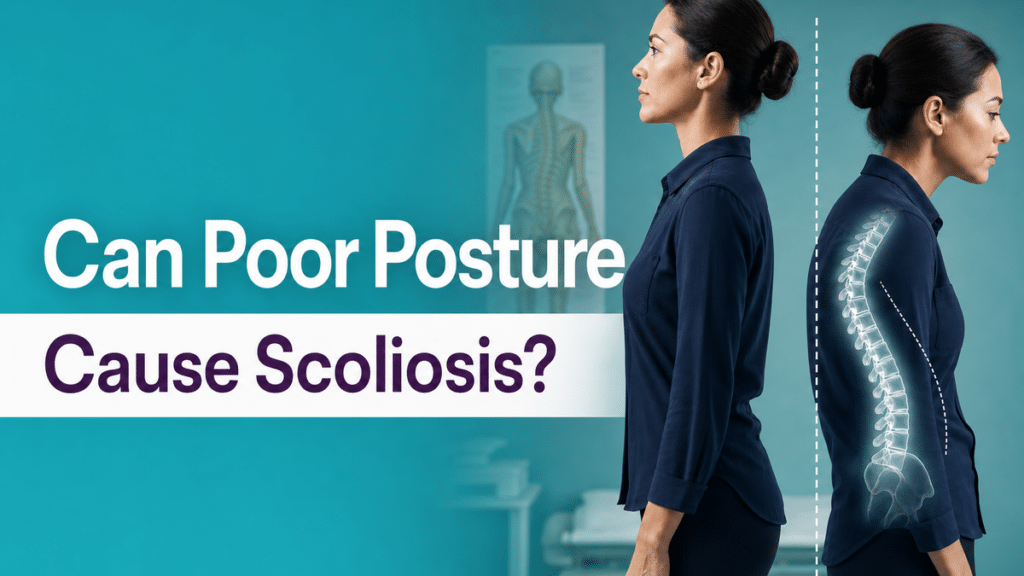
Postural health and spinal health are closely linked. A primary effect of scoliosis is asymmetrical posture, and improvements to a patient’s posture is a focus of scoliosis treatment. Posture shapes the types of forces the spine is exposed to over time, and a role of the spine is to maintain the torso’s straight and upright posture.
The main type of scoliosis is idiopathic scoliosis, with no known cause. While poor posture alone can’t cause scoliosis, it can contribute to the development of degenerative scoliosis in older adults. Poor posture also contributes to poor overall spinal health, which can increase curve progression. A main effect of scoliosis is poor posture.
The earliest signs of scoliosis in children are often uneven shoulders and hips.
Posture and Spinal Health
The spine is a complex structure with many moving parts and functions. The spine’s primary roles are movement, structural support, protecting the spinal cord and important organs within the thoracic cage, and facilitating healthy posture.
The spine allows us to stand upright and maintain the body’s straight and neutral alignment, but in order for the spine to fulfil this function, it also has to be balanced and aligned.
An aligned spine has its vertebral bodies stacked on top of one another in a straight and neutral alignment that allows for optimal function, but if the spine loses a healthy curve and becomes misaligned, its balance and stability are disrupted.
Postural assessment is always part of an initial consult or examination; I can tell a lot about a patient’s spine by posture.
Remember, posture doesn’t just shape how we look in terms of alignment and symmetry, it also shapes how we move, which shapes the types of forces the body is experiencing during movement and rest.
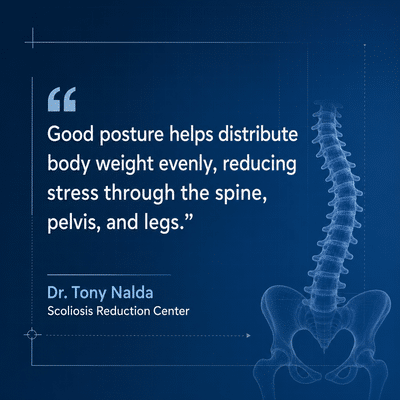
Posture shapes how body weight is distributed, and ideally, if the spine and body are aligned, mechanical stress is absorbed by the spine and evenly distributed throughout the spine, over the pelvis, and down the lower body.
A slouching posture, for example, involves leaning too far forward, and this shift can cause the upper body’s weight to be unevenly distributed over the pelvis, affecting lower body movement and function.
Poor posture doesn’t just affect the spine, but also its surrounding muscles, ligaments, and supportive structures, and if unhealthy movement patterns develop, the whole body is affected.
Scoliosis Causes
Scoliosis causes the spine to curve unnaturally to the side and rotate and is a complex structural 3-dimensional spinal condition.
There are different types of scoliosis with unique causes, and the most common type of scoliosis to affect all ages is idiopathic scoliosis, with no single-known cause.
So in most cases, we don’t know what triggers the initial onset of scoliosis, but we know growth is the main trigger for progression, but we also know that scoliosis can still progress without growth.
Adults have reached skeletal maturity but can still progress slowly over time, and even incremental increase can be significant when it comes to the spine’s balance and stability.
Less common types of scoliosi with known causes include neuromuscular scoliosis, congenital scoliosis, and degenerative scoliosis.
Neuromuscular scoliosis is caused by the presence of a larger neuromuscular condition such as spina bifida, muscular dystrophy, or cerebral palsy, so the scoliosis develops as a related complication, and not due to poor posture.
Congenital scoliosis affects babies born with scoliosis due to a malformed spine that develops in utero.
When it comes to the potential of poor posture to contribute to the development of scoliosis, this is most closely associated with degenerative de novo scoliosis.
Degenerative Scoliosis and Poor Posture
Degenerative scoliosis is caused by degenerative instability in the spine and is common in adults over the age of 45.
When it comes to overall spinal health, posture does play an important role, and degenerative changes in the spine develop slowly over time and are shaped by a number of important lifestyle factors.
Common lifestyle factors that contribute to poor spinal health over time and the onset of degenerative changes in the spine include carrying excess weight, too little exercise, improper lifting, and poor posture.
Carrying excess weight means more pressure on the spine, its discs and facet joints, and over time, can cause strain and damage. Carrying excess weight also contributes to poor posture.
A function of the spine is to support healthy movement patterns so its design is movement-based, and sedentary lifestyles doesn’t support pain health by contributing to weak core and back muscles for less spinal support, poor disc health, bone health, and spinal rigidity.
Particularly for people whose careers are labor-intensive and involves repeatedly lifting heavy objects, if the loads aren’t held close to the body and the back is used, rather than the legs, the spine and its supportive muscles and structures can be strained and damaged.
And poor posture can shape the spine’s overall health, and when it causes uneven wear and tear on the spine over the years, the spinal discs and feet joints can feel the effects, and trigger the onset of the degenerative cycle.
Postural decline is a primary cause of disability in older adults. Leaning too far forward or too far to one side will, over time, affect spinal function, and when there is a loss of spinal function, the legs and lower body are also affected.
Once the degenerative cycle is initiated, progression of 4 degrees a year is typical, which is significant.
Poor Posture and Curve Progression
So poor posture can contribute to poor spinal health, the onset of degenerative scoliosis, and it can also contribute to curve progression in all types of scoliosis.
It’s not just the spine that maintains its natural curves and alignment; it needs help from strong and balanced core and back muscles, ligaments, and supportive structures.
Poor posture exposes the entire body to uneven forces, not just the spine, and because the entire body is affected, it can contribute to curve progression.
A focus of scoliosis treatment is postural restoration because healthy posture is needed for a healthy spine, to sustain treatment results, to support healthy movement patterns, and to prevent degenerative changes and curve progression.
If the body is held in a straight and balanced alignment, so is the spine, and this helps counteract curve progression. The more stable and balanced the spine is, the less likely it is to become more unnaturally curved over time.
Postural Restoration
The importance of healthy posture, and the close connection between spinal health and postural health, is highlighted by the focus on postural restoration in treatment.
Scoliosis can be treated surgically or nonsurgically, and the invasiveness of spinal surgery, and the potential side effects and complications of spinal fusion, make nonsurgical treatment better for the spine’s long-term health and function.
Postural restoration involves awareness and recognition; patients are educated on the importance of healthy posture and how to recognize poor postural habits and their effects.
Nonsurgical Treatment Options
Nonsurgical treatment combines multiple scoliosis-specific treatment disciplines for the best potential results: corrective 3-dimensional bracing, physical therapy, targeted exercise, and Chiropractic BioPhysics®.
Corrective bracing has the goal of improving the spine’s position and 3-dimensional postural improvement and provides the support and stability to facilitate the spine and torso’s straight and upright position.
Scoliosis-specific physical therapy and targeted exercise has postural restoration as a primary focus. Through the use of Mirror Image exercise, patients can see how body posture affects movement and their scoliosis. Patients are taught how to position their spine and body during movement and rest to support the spine’s optimal alignment.
Being taught how to maintain healthy posture during movement reduces uneven forces experienced by the body and spine, helps with even weight distribution, and prevents the onset of degenerative changes in the spine.
Targeted exercise focuses on restoring the spine’s surrounding muscle balance and strength so the spine’s corrected position is supported and stabilized.
Chiropractic BioPhysics® can involve a number of chiropractic techniques and manual adjustments that work toward improving the position of the curve’s most-tilted vertebrae, and this im[pacts the underlying structural nature of scoliosis.
Conclusion
In most cases of scoliosis, the cause is unknown, and known causes include neuromuscular conditions, congenital defects, and degenerative changes in the spine.
While chronic poor posture can impact the spine’s overall health and contribute to curve progression, the underlying structural nature can’t be caused by poor posture alone.
Poor posture can contribute to the development of degenerative scoliosis that’s caused by the spine becoming increasingly unstable due to degeneration.
Poor posture that’s left unaddressed, over the years, exposes the spine and its structures to uneven pressure and wear and tear that contributes to the onset of the degenerative cycle, and the longer it’s left in place, the harder it is to break.
Here at the Scoliosis Reduction Center®, improving posture is a focus of treatment, and when it comes to degenerative scoliosis in older adults, improvements to posture can help restore the spine’s balance and stability for fall prevention.