
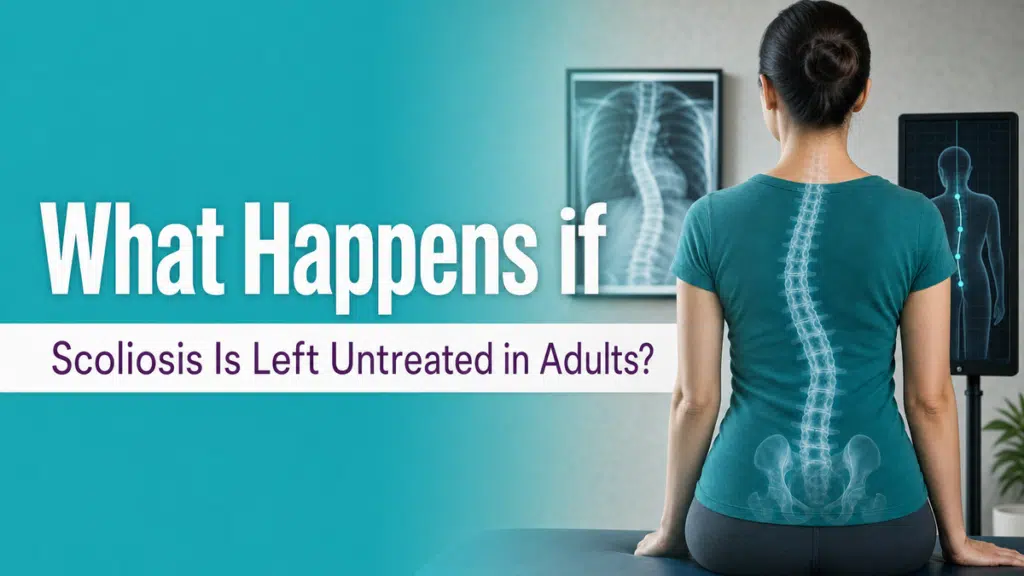
There are different types of scoliosis, and the two main types to affect adults are idiopathic scoliosis and degenerative scoliosis. Idiopathic scoliosis in adults may be pre-existing from adolescence and is likely to continue progressing if left untreated. Degenerative scoliosis affects older adults and can cause pain and disability if left untreated.
Scoliosis is most often diagnosed during adolescence, but it also affects adults. When it comes to the aging population, the rate of scoliosis increases, and this is due to the development of degenerative de novo scoliosis. If scoliosis is left untreated in adults, once the degenerative cycle is initiated, progression can occur quickly as the spine becomes increasingly unstable.
Leaving scoliosis untreated in adults can contribute to uneven wear and tear on the spine and trigger the onset of degenerative changes.
Adult Scoliosis
A diagnosis of adult scoliosis means an unhealthy sideways spinal curvature with rotation has developed in a skeletally-mature individual.
While many consider scoliosis a childhood condition, it affects all ages, and children and adults experience scoliosis differently and have unique treatment needs.
In childhood scoliosis, because progression is triggered by growth, a focus of treatment is on counteracting progression during growth. Treatment has to account for the constant trigger of growth occurring, but children also have more spinal flexibility, so many cases of childhood scoliosis are highly treatable.
In adult scoliosis, although growth is no longer occurring, incremental increases over time can add up to significant progression, even if it’s not progressing quickly, and in older adults, or once the degenerative cycle is initiated, adult scoliosis can progress quickly.
While adult scoliosis treatment doesn’t have to focus on counteracting progression due to growth, it does need to monitor the spine for degenerative changes, and scoliosis introduces uneven forces to the body that can translate to uneven wear and tear on the spine’s individual structures (discs and facet joints) and the spine’s surroundings.
As there are two main types of scoliosis that affect adults, let’s take a look at both with a focus on the effects of leaving them untreated.
Idiopathic Scoliosis in Adults
Idiopathic means no single-known cause, and the majority of scoliosis cases are idiopathic. The most prevalent form of scoliosis overall is adolescent idiopathic scoliosis diagnosed around the onset of puberty.
Adolescents, due to the rapid and unpredictable growth spurts of puberty, are the most at risk for rapid-phase progression, but mild cases can go unnoticed for years if postural changes are subtle and the condition isn’t painful.
Pain isn’t a primary symptom of childhood scoliosis because it’s not compressive. Once growth stops, scoliosis becomes compressive, and compression is uneven pressure that can cause pain and disability.
In cases of adolescent scoliosis that go unnoticed and untreated for years, it’s common that a diagnosis isn’t reached until adulthood, after a significant amount of progression has occurred, making the condition more overt and painful.
Diagnosing Idiopathic Scoliosis in Adults
The first step to diagnosing adult scoliosis is determining whether the scoliosis is pre-existing or new, and idiopathic scoliosis is the most common type to affect adults.
When an adult’s scoliosis is pre-existing from adolescence, the reality is an opportunity has been missed: early detection and intervention.
There are never treatment guarantees, but there are a number of benefits associated with starting treatment early, and when adults have had scoliosis for years, a lot of progression has likely occurred, and the condition’s effects are well established and more difficult to improve and/or reverse.
Progression makes the spine rigid and less responsive, so leaving idiopathic scoliosis untreated in adults can mean continued progression and increasingly-complex treatment needs.
Flexibility of the curve is an important factor when it comes to treatment response; part of diagnosing adult scoliosis involves assessing a patient’s level of spinal flexibility and range of motion.
In cases where spinal rigidity is severe, some preparatory work may be necessary to restore a baseline level of spinal flexibility before moving on to the next phase of treatment.
And when idiopathic scoliosis is left untreated, its uneven forces aren’t being addressed, and introducing uneven wear and tear to the spine and body can initiate a degenerative cycle that’s difficult to break.
Degenerative Scoliosis
Degenerative scoliosis develops later in life with no prior history and is also referred to as degenerative de novo scoliosis.
Degenerative scoliosis commonly affects adults over the age of 45 and is caused by degenerative changes in the spine.
Scoliosis exposes the spine, its individual structures, the spine’s surroundings, and the entire body to uneven forces that can have a number of effects.
The main visual effects of scoliosis in children and adults are postural changes; as an asymmetrical condition, scoliosis disruptes the body’s overall symmetry and alignment.
Poor posture is bad for spinal health, and poor spinal health is bad for posture: a vicious and damaging cycle. In adults, a postural shift can mean leaning too far forward or backward, and this type of uneven stress and weight distribution, over time, can cause the progression of adult scoliosis and/or the occurrence and progression of degenerative scoliosis.
Diagnosing Degenerative Scoliosis in Adults
Diagnosing degenerative scoliosis involves a comprehensive assessment regarding the spine’s balance and stability.
Most spinal degeneration starts with the discs that sit between adjacent vertebral bodies. Uneven pressure on the discs can cause them to wear unevenly, and if left unaddressed, over time, can cause a disc to lose hydration, change shape, and disrupt the position of adjacent vertebrae attached.
In addition, the facet joints that connect segments of vertebrae will also feel the effects of uneven wear, and if the discs and facet joints are degenerating, the spine will become increasingly unstable, and this puts adults at risk of injury through a fall; fall prevention is a focus of degenerative scoliosis treatment.
There is a certain amount of degeneration to be expected with age, but when it comes to spinal health, it’s crucial people understand that the cumulative effect of certain lifestyle factors can shape the spine’s level and rate of degeneration and long-term health.
Lifestyle factors capable of contributing to the onset of degenerative scoliosis include carrying excess weight that strains the spine, low activity levels that lead to weak core and back muscles, improper lifting that strains the spine and its supportive structures, and chronic poor posture.
If degenerative scoliosis is left untreated, increasing instability is dangerous, and lower back pain is a primary complaint that can disrupt quality of life and is a leading cause of disability in older adults.
Conclusion
Untreated scoliosis in adults is dangerous; it can lead to pain, instability, and increasing disability.
The more scoliosis progresses, the more unbalanced and unstable the spine becomes. Larger curves will become larger and more debilitating, whereas if treatment is started early and progression is prevented, corrections may be maintained through treatment and lifestyle guidance.
As a progressive condition, treatment needs are ongoing, so it’s important that patients understand all treatment options available to them.
Despite a patient’s age or severity level, it’s never too late to start treatment and work towards improvement, but the sooner scoliosis is diagnosed and treated, the better.
Here at the Scoliosis Reduction Center®, adult patients are treated with a proactive and customized treatment plan.
When scoliosis is left untreated, it can progress across the surgical threshold, and spinal surgery is invasive, and the risk of side effects and complications increase with age.
Untreated scoliosis can become very severe and cause complications such as lung impairment, cardiovascular issues, digestive issues, reduced mobility, headaches, pain, and disability.
Untreated scoliosis, regardless is when it initially develops, is likely to get worse over time, so continued progression is the most dangerous risk of untreated scoliosis at any age, and as progression makes treatment more complex, it can also funnel patients in the direction of more-invasive treatment options.