
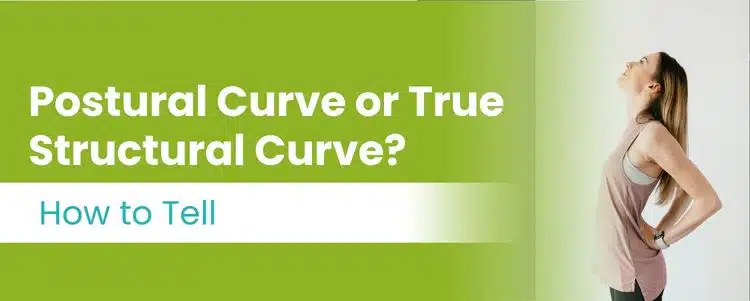
Postural scoliosis is nonstructural and is not a permanent condition. A postural curve doesn’t involve structural abnormalities with the spine’s vertebrae, including rotation. A true scoliosis means the spine’s misalignment is structural and involves vertebrae tilting and rotating unnaturally.
How to tell if a scoliosis is postural or structural is by observing how the spine responds to changes in position and X-ray results. An X-ray is needed to diagnose scoliosis; it has to confirm the presence of an unnatural sideways spinal curve with a rotational component. If changes to body position and posture alone correct the spine’s lateral curve, its postural scoliosis, not structural scoliosis.
Postural spinal conditions are nonstructural; they can be impacted by changes in position because they aren’t caused by structural abnormalities within the spine.
Diagnosing Structural Scoliosis
Diagnosing scoliosis isn’t always easy and is a comprehensive process.
From recognizing the condition’s, often subtle, early warning signs to seeking out assessment and diagnosis, there are a number of steps involved.
A typical scenario with the most prevalent type of scoliosis overall, adolescent idiopathic scoliosis, involves a parent noticing the development of asymmetrical posture; the earliest changes are often uneven shoulders and hips.
If signs of scoliosis are noticed, a trip to a family’s general practitioner for assessment is a common response. A thorough scoliosis screening examination should involve a physical examination, taking the patient’s family history and medical history, and an Adam’s forward bend test.
When it comes time to customize a scoliosis-specific treatment plan, however, a scoliosis-specialist is needed.
I can tell a lot about spinal health by a patient’s posture, gait, and strength. A healthy spine supports good posture, and healthy posture supports spinal health. Healthy posture is important for even weight distribution and healthy movement patterns. When the body is aligned and balanced, it wears evenly and degenerative changes to spinal health can be prevented, minimized, and managed.
In a screening examination, patients bend forward as if trying to touch their toes but leave the arms hanging neutrally at the sides while the spine and trunk are examined.
A forward-bend position makes the spine and trunk highly visible; if there are postural issues such as uneven shoulders, uneven shoulder blades, hips, and rib flaring, they’re the most overt in this position and are considered indicators of scoliosis that warrant further testing.
Scoliosis X-Ray
At this point, an X-ray would be ordered because this is the only definitive way to confirm, or rule out, the presence of scoliosis.
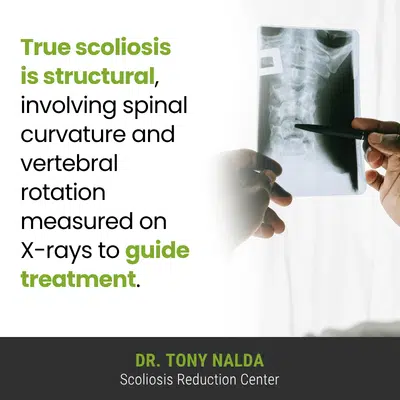
A true scoliosis is structural; the spine curves unnaturally to the side and its vertebrae rotate, and the severity of a patient’s curve size and angle of trunk rotation are determined during X-ray, and inform the customization of treatment plans.
In addition, structural scoliosis is a permanent progressive condition. Its nature is to become more severe over time, and the main progressive trigger in childhood scoliosis is growth, and in adult scoliosis, it’s degenerative changes to spinal health.
Postural Scoliosis
Postural scoliosis is not considered a true scoliosis.
Postural scoliosis is caused by functional issues, not structural abnormalities within the spine.
In cases of postural scoliosis, the vertebrae (bones of the spine) are healthy and normal and aren’t rotating (twisting), so the curve is flexible and simpler to correct.
Postural scoliosis can be caused by functional issues such as chronic poor posture, muscular imbalance, and/or asymmetric body irregularities.
Poor posture can, over time, cause stretched muscles and ligaments and a lack of support for the spine’s healthy position, and contribute to the development of muscular imbalance.
The spine needs support from its surrounding muscles, and poor posture introduces uneven tension that can impact the spine and its surrounding muscle strength, endurance, and balance.
Asymmetric body irregularities can include structural abnormalities elsewhere in the body such as leg length discrepancy where one leg is longer than the other or foot-alignment issues.
If one leg is longer than the other, the pelvis can compensate by tilting unnaturally in order to maintain the body’s upright position with the head level to maintain an even gaze.
Foot-alignment issues can include uneven pressure distribution that contributes to pelvic tilt and unnatural spinal curves developing to compensate and maintain balance.
Postural and Structural Scoliosis Treatment Options
Postural scoliosis is simpler to treat because the curve is flexible and because there are no structural abnormalities with the spine’s vertebrae, changes to body position alone can impact the curve.
Most cases of postural scoliosis respond to lifestyle modification and physical therapy. Through improvements to weight, activity level, and most importantly, posture, the spine can be held in optimal alignment throughout daily activity.
Physical therapy can help by increasing core and back muscle strength for more support, and a strong core facilitates healthy posture.
When it comes to treating structural scoliosis, the process is more comprehensive. Because no two cases of scoliosis are the same, treatment plans need to be fully customized, and when a multidisciplinary approach is taken, different treatments can be apportioned and adjusted accordingly throughout.
The key to structural scoliosis treatment is that it needs to be proactive because of progression. Progression means the spine’s unhealthy curve and rotation are increasing, and the effects of scoliosis are becoming more disruptive, established, and difficult to reverse and/or imp[rove.
In addition, the spine’s rigidity increases with progression, making it less responsive to treatment.
There are no treatment outcomes that can be guaranteed, but the sooner treatment is started, the more likely it is to be successful, and because scoliosis is a complex 3-dimensional condition, treatment success requires scoliosis-specific treatment delivered by a scoliosis specialist.
NonSurgical Scoliosis Treatment Options
Treatment plans commonly combine scoliosis-specific chiropractic care to impact the curve on a structural level; treatment can involve a number of techniques, including manual adjustments that work towards improving the position of the vertebral bodies that have shifted the furthest out of alignment with the spine.
In conjunction with improvements to the spine’s position, scoliosis-specific exercise targets the strength and balance of the spine’s surrounding muscles. Improving the strength, endurance, and balance of the spine’s surrounding muscles means more support and stability for the spine.
A stronger core also facilitates healthy posture by maintaining the torso’s straight and upright position.
Scoliosis-specific exercise is corrective and also involves the use of Mirror Image® exercise to teach postural awareness and restoration; educating patients on how to hold the body and maintain its alignment during daily activity is key to long-term improvements to spinal health and sustaining treatment results.
Corrective scoliosis bracing complements scoliosis-specific exercise by working towards the same goal of improving the spine and body’s 3D alignment.
The ScoliBrace® holds the spine in an untracorrective position and supports the torso’s alignment, and because the ScoliBrace® is often prescribed for full-time wear, it strengthens the connection between the brain, the spine, its supportive muscles, and the body’s improved alignment; the goal is the spine’s alignment and body posture is maintained when out of the brace.
When scoliosis-specific treatment is proactive and integrative, there are fewer limitations to what nonsurgical treatment can achieve.
Conclusion
So how can you tell if you have a postural or a structural scoliosis? An X-ray is needed to confirm the presence of an unnatural structural lateral spinal curve with rotation, making it a 3-dimensional condition, and a structural scoliosis.
Treatment success will depend on a number of factors, one of which is that the scoliosis is addressed on all levels: correcting the spine’s unnatural curve, rotational component, and improving the spine’s surroundings muscle balance and strength.
A structural scoliosis is a permanent progressive condition; treatment is needed to manage progression, minimize symptoms, and prevent the need for surgical intervention.
Postural scoliosis is recognized by how the spine responds to changes in body position. If a prominent to one side, for example, can be corrected through mindful movement and improvements to posture, the curve is postural.
When it comes to correcting a structural scoliosis, treatment needs are more comprehensive. Here at the Scoliosis Reduction Center®, treatment plans are customized and evidence-based.
Through the integration of scoliosis-specific chiropractic care, physical therapy, and corrective 3-dimensional scoliosis bracing, improvement made to the spine’s alignment will benefit its balance and stability, and improvement made to the spine’s surrounding muscle health is essential for increasing spinal support.