
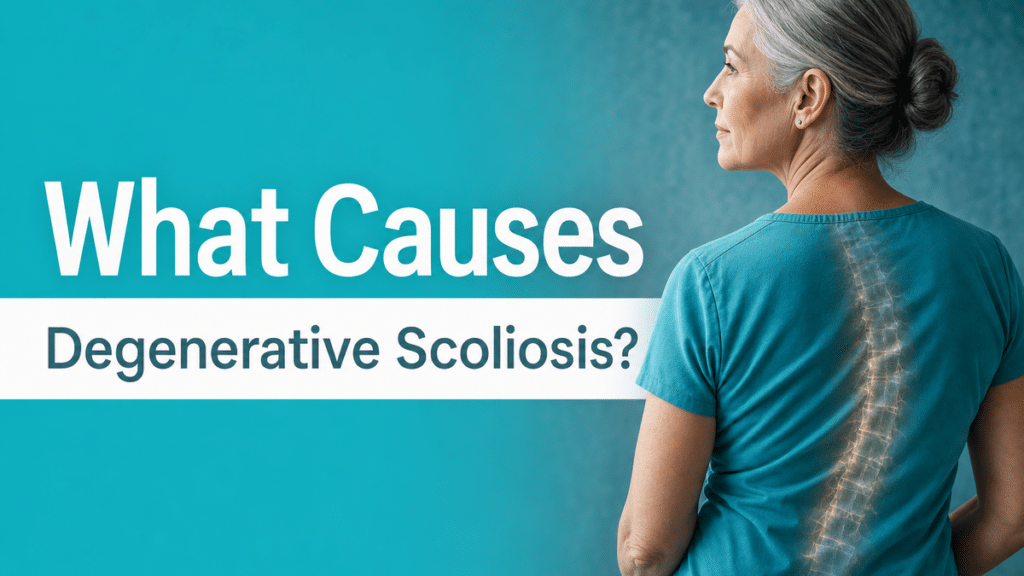
Degenerative scoliosis develops later in life, and while adolescents are more frequently diagnosed, the actual rate of scoliosis increases among the aging population. Degenerative changes to spinal health can be age-related and shaped by the cumulative effect of lifestyle factors shaping spinal health over time.
Degenerative scoliosis affects older adults experiencing degenerative changes to spinal health. In most cases, it’s the intervertebral discs that are the first spinal structures to degenerate, and increasing degenerative instability puts older adults at risk.
A number of controllable factors contribute to the development of degenerative scoliosis, one of which is poor posture, so healthy posture is key to maintaining long-term spinal health.
Degenerative Scoliosis Causes
While the most common type of scoliosis, idiopathic scoliosis, has no known cause, there are atypical types that are associated with known causes: neuromuscular scoliosis and degenerative scoliosis.
Neuromuscular scoliosis is caused by the presence of a larger neuromuscular condition that has to be the focus of treatment, and degenerative scoliosis involves the spine, most often the lumbar spine, developing an unnatural lateral spinal curve with rotation.
The rotational component of scoliosis sets it apart from a number of spinal conditions that cause a loss of healthy spinal curves.
Degenerative scoliosis is caused by degenerative instability and affects older adults. Unlike idiopathic scoliosis in adults with most cases involving pre-existing adolescent scoliosis, degenerative scoliosis develops later in life with no prior history.
Degenerative scoliosis tends to be severe and/or can become severe quickly due to increasing instability; early detection and intervention can help.
While there is a certain amount of degeneration to be expected with age, there are lifestyle factors that contribute to the timing of its onset, severity, and rate, and when it comes to the spine, as the body’s central structural anchor, its position is key to overall health and quality of life.
Lifestyle and Spinal Health
Over time, the cumulative effect of lifestyle factors impact spinal health; carrying excess weight, too little exercise, chronic poor posture, and repeatedly straining the spine through improper lifting of heavy objects can initiate a cycle of poor posture, uneven weight distribution, and asymmetric wear and degeneration.
Carrying Excess Weight
Carrying excess weight puts pressure on the joints and discs of the spine and also is associated with poor posture, and the spine’s natural design is movement-based, so a sedentary lifestyle can be damaging to spinal flexibility and range of motion, the spine’s surrounding muscle strength for support, and disc health.
Too Little Exercise
The discs don’t have their own vascular supply so depend on pressure changes and good circulation, through movement, to stay hydrated and absorb important nutrients from their surroundings.
The facet joints connecting vertebrae also suffer from uneven pressure and lack of movement, and as they facilitate the smooth gliding motion of the vertebrae during movement, their degeneration can mean friction, excessive wear, and pain.
Poor posture and weakening ligaments and muscles are primary causes of disability in older adults, often triggering changes to mobility, strength, and pain.
Weak Core and Back Muscles
As we age, it takes more effort to maintain muscle strength and endurance, and weakening muscles and ligaments can contribute to the spine’s lack of support and misalignment.
It’s not just the spine that maintains its optimal alignment; it’s also the work of the spine’s surrounding muscles and supportive structures.
A focus of scoliosis treatment is increasing core strength for more support and stability for the spine, and to support healthy posture and movement patterns.
Improper Lifting
Particularly for people whose careers involve repeatedly lifting heavy objects, overuse injury and strain can initiate a cycle of poor posture and degeneration that may be difficult to stop.
Understanding the importance of ergonomics, when it comes to long-term spinal health, is key. Lifting with the legs, rather than straining the spine, and keeping weight close to the body is important.
Being mindful of posture during movement and strenuous lifting is essential. The spine and body should always be held in an aligned position.
Health of the Lumbar Spine
Most cases of degenerative scoliosis develop in the lumbar spine. The lumbar spine has the largest and strongest vertebrae because of their load-bearing nature; they have to support the weight of the thoracic spine, the cervical spine, and the upper body.
The lumbar vertebrae feel the strain of bending, lifting, and twisting motions.
The lumbar spine also connects directly to the pelvis so its health and position shapes pelvic and hip alignment, further shaping lower body health and mobility.
Degenerative scoliosis is driven by a number of ag-related factors, and if the discs and/or facet joints of the lumbar spine are degenerating, asymmetric loading and wear is occurring, and the longer it’s left unaddressed, the more damaging it can be.
Poor Disc Health
If the lumbar spine is affected by degenerative disc disease, one or more discs in the lower back can lose fluid and change shape, affecting the position of an adjacent vertebrae attached, and shifting the spine out of alignment.
Osteoarthritis
Facet joint arthritis can also cause degenerative scoliosis; if the small joints connecting vertebrae are experiencing a loss of cartilage, friction can cause instability and unhealthy movement within the spine.
Osteoporosis
Osteoporosis is also common in menopausal females experiencing changes to bone density and vertebral compression fractures as a result of weakened bones.
Spondylolisthesis
If spondylolisthesis develops in the lower back, one vertebra shifts out of alignment in relation to the vertebral body below, causing shifting and instability.
While the spine’s natural design is movement-based, too much movement within the spine means changes to balance, coordination, and stability.
Degenerative Scoliosis Symptoms
The most noticeable symptoms of degenerative scoliosis include poor posture and pain. Because the degenerative cycle has been initiated, degenerative back pain can be chronic, severe, and debilitating.
Nerve compression can also cause radiating pain in the extremities and because the condition is degenerative, progression is likely and could be rapid.
Lower back pain is the most common degenerative scoliosis symptom, and if left untreated, adults are at risk of increasing changes to balance, gait, and injury through a fall.
Degenerative Scoliosis Treatment Options
Degenerative scoliosis treatment is essential, and early intervention is key. The sooner a degenerative condition is diagnosed, the sooner it can be addressed to preserve spinal function and prevent further damage.
Here at the Scoliosis Reduction Center®, treatment plans are customized and proactive. Started immediately following a diagnosis of degenerative scoliosis, adults are comprehensively assessed to determine how flexible, and unstable, their spine is.
Spinal flexibility is a determining factor in treatment, and a focus of degenerative scoliosis treatment is the potential of scoliosis-specific rehabilitative exercise to increase core strength, address any muscular imbalance, increase the spine’s flexibility for treatment responsiveness and improvements to pain and range of motion, curve reduction, and proper posture.
Educating adults to recognize and correct poor posture is essential; the spine has to be held in an optimal alignment during daily activity to sustain treatment results and prevent further asymmetric loading and degeneration.
Corrective bracing can also be used for pain relief and to stabilize the spine, and scoliosis-specific chiropractic care can target the position of the spine’s most unnaturally-tilted vertebrae; as a structural spinal condition, the underlying structural nature has to be impacted with treatment, along with improvement stop core and back muscles strength and balance.
Conclusion
Degenerative scoliosis is caused by degenerative changes to spinal health that most often involve the intervertebral discs and facet joints.
It’s never too late to start scoliosi treatment. The goal of degenerative scoliosis treatment is to restore a healthy level of stability in the spine by increasing its support from strong and balanced muscles and postural restoration.
A focus of degenerative scoliosis treatment is fall prevention. Improving the spine’s stability means improvements to posture and mobility, and even incremental improvements to posture and the spine’s alignment can benefit the entire body.
Pain management is important for quality of life, and when it comes to the onset of spinal degeneration, leading a spine-friendly lifestyle can prevent the initiation of a damaging cycle of postural changes, uneven forces, and degeneration.
A misaligned spine that’s left unaddressed can become increasingly unstable and painful and is a leading cause of disability in the aging population.
Improving posture and spinal health can impact quality of life, and ultimately, a better quality of life is what we want for all the Center’s patients.