
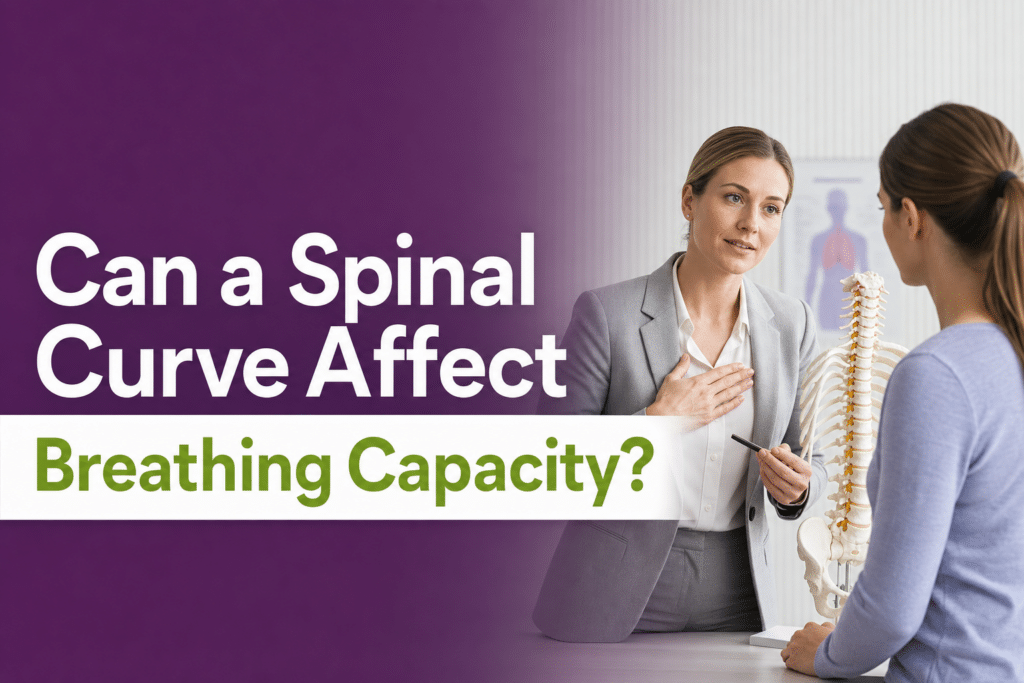
An unnatural spinal curve can affect breathing capacity by causing a loss of space within the chest cavity and compressing the lungs within. Scoliosis causes the spine to curve to the side and rotate unnaturally; this introduces uneven forces to the spine and its surroundings.
Breathing problems aren’t considered a primary symptom of scoliosis and are most closely associated with cases of severe thoracic scoliosis. The thoracic spine is the only spinal section attached to the rib cage; as the thoracic spine disrupts the position of the rib cage, it can cause a loss of space within the chest wall and compress the lungs.
An unnatural spinal curve can cause a number of effects from postural and mobility changes to pain and complications.
Primary Effects of Scoliosis
It’s important to understand that no two cases of scoliosis are the same. Treatment plans need to be fully customized to address the specifics of a patient’s scoliosis and treatment goals.
Not only does scoliosis range from mild to very severe, there are also different types of scoliosis with unique causes and treatment needs.
Scoliosis also affects all ages, but affects varying age groups differently.
As a progressive spinal condition, the nature of scoliosis is to become more severe and disruptive over time. Cases initially diagnosed as mild are unlikely to stay that way, particularly while growth is occurring.
Growth is the main trigger for progression in children, and degenerative changes to spinal health can increase progression in adults.
The most prevalent type of scoliosis overall is adolescent idiopathic scoliosis diagnosed around the onset of puberty and into young adulthood, but scoliosis affects all ages; in fact, while scoliosis is diagnosed mainly during childhood and regarded by many to be a childhood condition, the actual rate of scoliosis increases among the aging population.
When degenerative changes start occurring in the spine, either due to the cumulative effects of lifestyle factors and/or because of an unnatural spinal curve, early intervention is essential. The more the spine and its surroundings are exposed to uneven pressure, particularly during movement, the more uneven wear is occurring, and the degenerative cycle can be a difficult one to break.
The primary effects of childhood scoliosis include postural and mobility changes. Uneven shoulders and hips are often the earliest signs, and changes to gait, balance, and coordination are also common.
While adults also experience postural changes and a noticeable lean to one side, back and nerve pain are the primary effects that lead to assessment and diagnosis.
Scoliosis and Breathing Problems
Scoliosis doesn’t commonly cause breathing problems, particularly in cases of childhood scoliosis that aren’t compressive.
Compression refers to uneven and/or excessive pressure, and scoliosis doesn’t become compressive until skeletal maturity has been reached, which is why many cases of adolescent scoliosis aren’t diagnosed until after growth stops; this is often when back and nerve pain develop.
Scoliosis breathing problems are more closely related to compressive scoliosis that occurs in adulthood, and even in some cases of adult scoliosis with reduced lung function, patients may not notice; lung impairment caused by scoliosis is most likely to be noticed by professional athletes or those who place extra demands on their respiratory systems.
Cases of scoliosis can range from mild scoliosis to moderate cases, severe and very severe scoliosis, and the more severe a patient’s scoliosis, the more noticeable its symptoms are, and as a progressive condition, severe cures are likely to continue progressing, particularly in left untreated.
So let’s talk about the factors that make breathing problems the most likely for scoliosis patients.
Condition Severity
Mild scoliosis involves small curves and subtle symptoms. Despite the importance of early detection, diagnosing scoliosis while mild can be a challenge when its effects are subtle and functional deficits are rare.
It’s important for patients to understand, however, that even cases diagnosed as mild are unlikely to stay that way. Mild scoliosis can easily progress and become moderate, severe, or very severe with growth and/or degenerative spinal changes in older patients.
Most cases of scoliosis are diagnosed as moderate because enough progression has occurred from mild to moderate to cause noticeable symptoms that lead to assessment and diagnosis.
So in mild and even moderate cases, breathing problems aren’t common, but once progression crosses the severe threshold, symptoms can be overt, disruptive, and progress quickly.
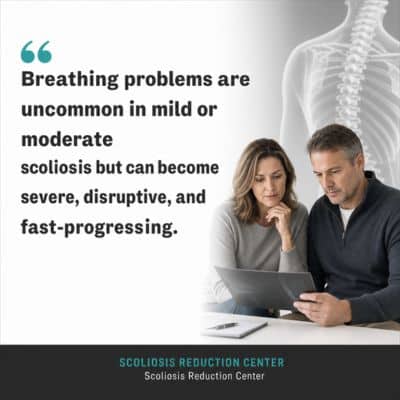
Severe scoliosis involves a large unnatural s[pineal curve capable of causing more severe effects, one of which is disrupting lung function. Breathing problems are a common complication of untreated scoliosis.
In addition to severity, location of the curve is also important when it comes to potential breathing problems.
Curve Location
Scoliosis can develop in any of the spine’s main sections: cervical spine (neck), thoracic spine (middle/upper back), and the lumbar spine (lower back).
Scoliosis most often affects the thoracic spine, which is the largest spinal section, and as the only section that attaches to the rib cage, the most likely to impact lung function.
The thoracic spine contains 12 vertebral bodies, and with the rib cage, forms the thoracic cage; the thoracic cage protects important organs within such as the heart, the lungs, and a number of digestive organs.
If the thoracic spine is curving unnaturally to the side and rotating, it’s pulling unevenly on the rib cage, commonly causing rib flaring where one side of the rib cage protrudes more than the other side, and this can cause a loss of space within the chest wall.
If the rib cage is being compressed, it can be difficult for the lungs to fully expand and may cause shortness of breath, shallow breathing, and fatigue.
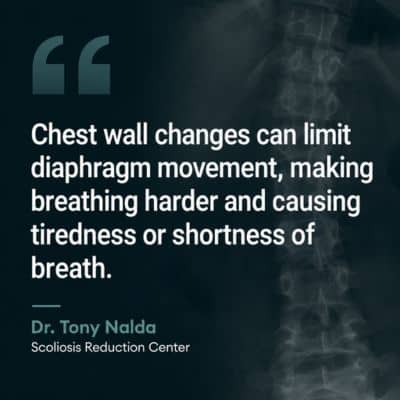
The chest wall changes can also restrict movement of the diaphragm, causing muscles of the respiratory system to work harder; tiredness and shortness of breath may develop even during low-impact activity.
So we know that breathing problems caused by scoliosis aren’t common, but can develop in severe cases, and we know they’re most common in severe cases of untreated thoracic scoliosis, so what are the treatment options?
Scoliosis Treatment Options
There are no treatment guarantees, but particularly with early detection and intervention, the scope of nonsurgical treatment is wide.
The goal of a proactive nonsurgical treatment approach is to prevent progression so complications such as breathing problems never develop.
Proactive treatment plans are started immediately following a diagnosis because as a progressive condition, scoliosis is highly likely to get worse over time, and merely observing scoliosis can lead to curves progressing unimpeded and becoming more complex to treat.
When it comes to preventing severe symptoms and complications like lung impairment, the goal is preventing progression; no treatment outcome can be guaranteed, but in many cases, scoliosis is highly treatable and responds well to a proactive nonsurgical treatment plan.
Here at the Scoliosis Reduction Center®, treatment disciplines are customized and combined to address the specifics of a patient’s scoliosis, and while impairments to lung function is not a common effect of scoliosis, improvements to spinal alignment can reduce pressure on the lungs.
As the underlying cause of the breathing problems is compression caused by the scoliosis, the scoliosis itself needs to be impacted on a structural level.
Scoliosis-Specific Chiropractic
With improvement to the spine’s alignment through scoliosis-specific chiropractic adjustments and care, the spine’s balance is restored, and this reduces uneven pressure on the spine’s surroundings, including the rib cage and lungs.
As the spine’s position is improved, the unnatural pull on the rib cage is reduced, relieving pressure on the lungs and allowing them more space to fully expand and function within.
And chiropractic care is supported by a scoliosis-specific physical therapy plan and corrective bracing, when needed.
Scoliosis-Specific Physical Therapy
Strengthening and balancing the spine’s surrounding muscles is the focus of physical therapy for scoliosis as this gives the spine more support, stability, and takes pressure off its individual structure and surroundings.
A spine that’s well supported is more functional with help maintaining its optimal alignment.
Physical therapy also teaches postural awareness and restoration. Postural health and spinal health are closely connected, and educating patients on how to recognize poor posture and correct it, particularly during movement, offers long-term improvements to spinal health.
Corrective Bracing
Corrective bracing, such as the ScoliBrace®, offers additional support and correction through pushing the spine into a straighter alignment, and because it’s designed to work with movement, it works with scoliosis-specific exercise towards the common goal of improving the spine and body’s 3-dimensional alignment and posture.
Conclusion
An unnatural scoliotic curve can cause breathing problems, although it’s not common. The most common type of scoliosis is idiopathic scoliosis, with no known cause, and these mainly involve typical cases that range from mild to very severe.
In mild scoliosis and moderate cases, lung function is rarely affected, but if progression causes scoliosis to become severe, it can affect breathing by causing a loss of space within the chest wall for the lungs to function within.
If the lungs are exposed to uneven pressure, their ability to fully expand can be affected, and shortness of breath, shallow breathing, and fatigue are common indicators of lung function impairment.
It is important to note, however, that even in some cases of severe scoliosis, if lung function is affected, it’s not always noticed; many times, changes to lung volume are only noticeable to professional athletes and/or patients who place higher-than-average demands on their respiratory systems.
When lung volume is affected, the best way to improve lung function is to address the underlying cause of the lung compression: the scoliosis.
Severe cases of thoracic scoliosis are the most likely to affect lung function and cause breathing problems, but in many cases, with a proactive treatment plan, progression into the severe stage can be prevented.
We don’t always know what causes scoliosis to develop initially, but we know that all types and severity levels can benefit from treatment, and we also know the sooner treatment is started, the better.