

Parents caring for a child with scoliosis need to clearly understand the child’s curve and situation. When it comes to childhood scoliosis, a key factor is a patient’s curve progression risk. Some scoliosis curves may not increase in size, but most will if growth or age-related changes to spinal health are occurring. There are a number of ways clinicians predict how much a patient’s curve may progress including the Sanders method.
The Sanders score for scoliosis is a staging system that assigns a numerical value on a scale of 0 to 8 to a child’s level of skeletal maturity based on an X-ray of the hand and wrist. The method is often used for managing adolescent curves by predicting the amount of vertical growth a patient has left before reaching skeletal maturity.
Knowing how much growth and potential progression a patient has matters because once growth stops, curves are more rigid and may be more difficult to correct.
Diagnosing Scoliosis
Scoliosis affects patients of all ages, but it’s most often diagnosed during adolescence as adolescent idiopathic scoliosis in patients 10+ years old and into young adulthood.
Having a child diagnosed with scoliosis can be emotional for patients, parents, and families, and parents should know there are a number of treatment options available, and the sooner a child’s curve is diagnosed, the better.
Scoliosis describes an unnatural lateral spinal curve with rotation, and as a progressive condition, when there are certain factors in place, such as growth or degenerative disc disease in older adults, its nature is to increase over time.
Scoliosis is usually diagnosed during an adolescent growth spurt, when growth is causing progression that’s causing increasing symptoms such as noticeable postural changes, muscle pain, and/or back pain.
Part of diagnosing scoliosis involves classifying curves based on key variables that treatment is shaped around, and particularly when it comes to childhood curves, knowing how much potential growth a patient has indicates their potential progression.
The more we know about a patient’s curve and how it may progress, the easier it is to tailor a treatment plan accordingly.
The Sanders score for scoliosis is a method for determining a patient’s bone age because it’s a more reliable indicator of progression than chronological age (1). Patients of the same age can grow at different rates and reach significantly different heights. This matters for treatment planning and proactive curve management during growth (2).
Sanders Score for Scoliosis
There are a number of methods for evaluating a patient’s potential rate and amount of curve progression, and the Sanders score is determined with a single X-ray image of a patient’s wrist and hand. The scale is from 0 to 8 and assigns a numerical value to skeletal milestones and levels of bone maturity (1).
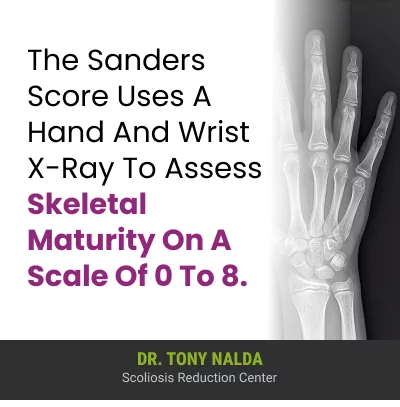
At a score of 0-2, for example, a child has a lot of remaining growth before completing their growth potential, and a score of 3 is a key skeletal milestone that means the patient is in their peak height velocity stage. Because growth is happening at such a fast rate, risk of curve progression is usually highest.
Children with a score of 4 to 6 are experiencing a slower rate of growth as certain bones are starting to fuse. At score 7, patients are almost at full skeletal maturity, but the spine and trunk height can still change, and a score of 8 means growth plates are closed and full skeletal maturity has been reached.
In most cases, curve progression slows or stops when there is no more growth, and when the spine is no longer growing, it becomes vulnerable to the compressive forces of the spine’s unnatural curve and twist, and its position is more rigid.
Usually, a rigid curve has less corrective potential than a flexible curve.
Why a Sanders Score Matters for Treatment
Managing curve progression in childhood can be a challenge due to growth, but because growth maintains the spine’s flexibility, it also supports correction (2).
The goal is to diagnose scoliosis early so curves can be addressed during growth. Growth of the spine is complex, and it doesn’t take much to shift its pattern and cause a malformation. The uneven forces of the scoliosis curve can affect the growth of the spine’s growth plates that further advance the deformity.
Timely management is key. Starting treatment while the spine is still growing and flexible can be an advantage when the curve is diagnosed and managed through growth, before peak growth spurts have triggered significant progression (2).
A child’s Sanders score matters for predicting progression and how much remaining progression the curve may go through, and it matters for the types of treatment recommended (1).
The Timing of Treatment
Scoliosis bracing, for example, may involve tracking a patient’s Sanders score to determine when it’s the best time to start weaning patients off the brace. Stopping bracing too early may undo some of its effects, and progress past stage 7 is usually a safe time because growth is almost complete.
For patients with severe curves who have not responded to conservative treatment options, surgical intervention may be recommended, and decisions regarding spinal fusion and specialized intervention are also made around a patient’s level of skeletal maturity.
Knowing a patient’s bone age helps determine the ideal time to start treatment and the optimal treatment options to recommend. Bracing is more effective on growing spines, but starting bracing after a significant amount of progression has already occurred means the spine needs more correction and may be more difficult to impact (1).
Studies also show that pairing bracing with a scoliosis-specific exercise program increases bracing efficacy when started and combined at the right time (3), but each patient’s curve is unique, and treatment recommended to one patient may not be suitable for another.
A thorough assessment provides patients and families with guidance on whether a curve needs treatment, when to start treatment, and the most suitable treatment options.
Risser Sign for Scoliosis
As stated, there are a number of variables to consider when predicting a patient’s curve progression risk, and determining a patient’s Risser sign is another common scoring system for assessing bone age.
Instead of using the stage of bone maturity in the hand and wrist, the Risser sign uses the pelvis, specifically the top of the hip bone (iliac apophysis) to rate its level of bone ossification.
The Risser scale is from 0 to 5, and patients with a low Risser score have a lot of remaining growth and potential progression, while patients with a higher score are closer to bone maturity with complete iliac crest fusion happening at stage 5.
Other important factors that help us predict a patient’s progression risk is curve location, direction, and severity. Thoracic curves are the most common and because the middle/upper spine attaches to the rib cage, there is usually more rotation and progression, and right curves are more common and tend to advance faster than left curves, and larger curves are also more likely to continue progressing because the spine is more off balance and becomes increasingly unstable.
The Sanders score is considered more reliable for assessing skeletal maturity, particularly during early childhood, than the Risser scale (1).
Conclusion
Parents with a clear understanding of their child’s curve and progression risk can make informed treatment choices and better support and advocate for their child.
Treating childhood scoliosis involves a lot of variables, From chronological age and bone age to curve progression and growth spurts, childhood curves can change quickly when growth is happening.
One of the best ways to manage a curve during a curve acceleration phase is to know progression is coming, how much progression, and how fast it may occur. This allows us to manage the curve through growth, instead of trying to reverse it, and its effects, after it’s triggered curve progression.
The Sanders score uses the stage of bone maturity in the head and wrist determined from a single X-ray image and assigns it a number on a scale of 0 to 8. Low scores mean more growth and potential progression, and high scores mean less growth and a lower curve progression risk in most cases.
Here at the Scoliosis Reduction Center®, all factors that may be leading to progression are considered when assessing a patient’s spine for treatment recommendations.
References:
- Hori Y, Kaymaz B, da Silva LCA, Rogers KJ, Yorgova PK, Gabos PG, Shah SA. Differences in spine growth potential for Sanders maturation stages 7A and 7B have implications for treatment of idiopathic scoliosis. Spine Deform. 2024 May;12(3):621-628. doi: 10.1007/s43390-024-00829-8. Epub 2024 Feb 19. PMID: 38372941; PMCID: PMC11068661
- Negrini, S., Donzelli, S., Aulisa, A. G., Czaprowski, D., Schreiber, S., de Mauroy, J. C., … & Zaina, F. (2018). 2016 SOSORT guidelines: orthopaedic and rehabilitation treatment of idiopathic scoliosis during growth. Scoliosis and spinal disorders, 13(1), 3
- Karavidas N, Tzatzaliaris D. Brace and Physiotherapeutic Scoliosis Specific Exercises (PSSE) for Adolescent Idiopathic Scoliosis (AIS) treatment: a prospective study following Scoliosis Research Society (SRS) criteria. Arch Physiother. 2022 Nov 1;12(1):22. doi: 10.1186/s40945-022-00150-5. PMID: 36316760; PMCID: PMC9624025