
Timing matters in scoliosis treatment because as a progressive condition, scoliosis can change quickly. Growth is the main trigger for childhood scoliosis progression, and while there are other factors such as curve size and pattern that contribute to whether a patient’s scoliosis is stable or progressive, the timing of treatment also plays a role.
A patient’s risser sign is determined during X-ray to assess skeletal maturity. The risser sign grades a patient’s level of bone age to help predict remaining skeletal growth. Because patients grow at different rates and growth triggers progression, bone age may be more helpful than patient age when assessing a patient’s risk of curve progression.
A child’s scoliosis treatment plan is shaped around a number of factors, including whether they are at a high risk for curve progression.
What’s a Risser Sign?
A risser sign is a medical scale from 0 to 5 used to estimate a patient’s level of bone maturity and how much at risk a child is for their scoliosis to become more severe.
A pelvic ultrasound considers the levels of ossification of the iliac crest apophysis (pelvic bone maturity) as an indicator of how much overall skeletal growth a patient has remaining. A lower risser grade indicates a lot of growth and progression potential, while a higher risser grade suggests less remaining growth and a lower risk of curve progression.
Determining a patient’s risk of curve progression is essential for understanding how to manage progression during growth and respond with appropriate treatment options.
Scoliosis causes an unnatural lateral spinal curvature with rotation, and while some curves are stable, others can become larger, and curves are more likely to be progressive in young patients with ongoing growth than patients who have reached full skeletal maturity.
So a risser sign indicates a patient’s bone age, which is more important than patient age when it comes to curve progression, because patients of the same age with the same curve size can grow at different rates and experience different rates of progression.
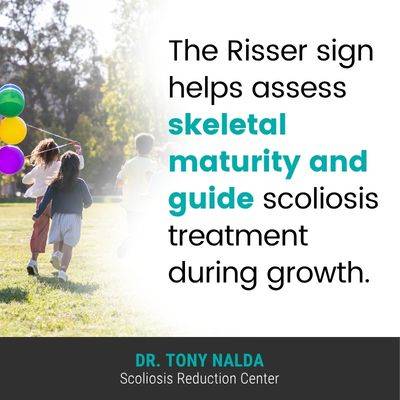
Scoliosis specialists have a lot to consider when treatment decisions are being made, and a system to classify skeletal maturity, such as determining a patient’s risser sign, directs scoliosis management during growth.
The Timing of Treatment Matters
With progressive conditions like scoliosis, the timing of treatment can be an important factor. While there are no treatment outcomes I can guarantee, studies support the value of early detection and intervention, particularly in childhood scoliosis.
Scoliosis affects all ages, but it’s most often diagnosed in children and teens, and the most common type of scoliosis overall is adolescent idiopathic scoliosis diagnosed between the age of 10 and when skeletal maturity is reached.
The timing of diagnosis can matter because in cases that are progressive, scoliosis can change quickly during growth spurts, and because adolescents are entering into the stage of puberty characterized by rapid and unpredictable growth spurts, rapid progression is a risk.
Scoliosis that’s progressing is increasing in size, and in most cases, this makes its effects more noticeable and disruptive, and in some cases, more difficult to improve or reverse.
The spine itself becomes more rigid once growth stops, its position is more fixed, and if a curve is progressing, the spine can become increasingly rigid and less responsive to treatment.
Because scoliosis isn’t a static condition, it’s always changing, and comprehensive assessment is recommended at all stages. It can be affected by lifestyle factors, growth, posture, declining spinal health, and more, so starting treatment early when curves are smaller and more flexible may help patients avoid some effects of progression.
Scoliosis symptoms vary from patient to patient, but increasing symptoms often caused by progression include noticeable uneven posture, pain, muscular imbalance, and disruptions to balance, coordination, and gait.
Nonsurgical Scoliosis Treatment
The goal of nonsurgical scoliosis treatment is to correct a patient’s scoliosis by improving the spine’s healthy alignment and increasing its support from surrounding muscles. When scoliosis is treated proactively, progression may be manageable or even preventable, sparing patients the challenges of increasing symptoms, and nonsurgical treatment is more likely to be successful when it’s started early.
The more I know about a patient’s scoliosis, the better equipped I am to make appropriate treatment recommendations, and another goal of nonsurgical scoliosis treatment is to help patients avoid a surgical recommendation in the future.
If a child’s curve progresses past the surgical threshold, it may be too late to improve the spine’s position with less-invasive treatment options, and spinal fusion surgery isn’t always the best for long-term spinal health.
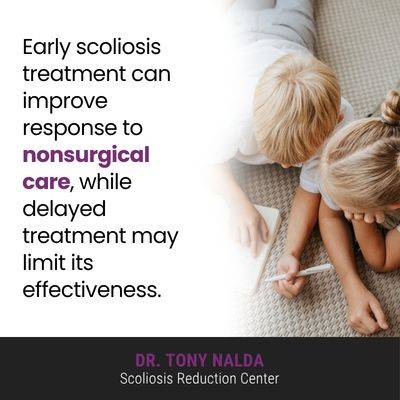
Many cases of scoliosis, particularly with early detection and intervention, are highly responsive to nonsurgical treatment, but regardless of how effective a treatment option is, if it’s not started at the right time, its potential effectiveness may be limited.
Two main factors in scoliosis treatment planning are curve size and risk of curve progression, so if a patient with a large scoliosis curve is given a low risser sign that indicates a lot of growth potential, a focus of treatment planning is counteracting rapid progression because larger curves are more likely to progress than mild curves, and more growth potential can also mean more potential progression.
Like a patient’s risser sign, curve size is also determined during X-ray. A measurement known as Cobb angle classifies scoliosis as mild, moderate, severe, or very severe, and it’s essential that a patient’s Cobb angle is measured accurately because changes to the measurement can indicate if progression is occurring and/or whether treatment is working.
Risser sign is important for nonsurgical treatment planning because two young patients can be diagnosed with scoliosis at the same age and with curves of the same size, but if they are growing at different rates, treatment planning needs to account for different rates of progression.
Nonsurgical Treatment Options and Growth
Nonsurgical scoliosis treatment options are customized because a treatment plan should be as unique as the patient.
Scoliosis treatment has to address the spine’s unnatural curve and twist, but it also needs to manage progression effectively during growth, and a patient’s risser sign helps predict if a progressive curve will respond to scoliosis-specific physical therapy, targeted scoliosis-specific exercise, corrective bracing, scoliosis-specific chiropractic care, or a combination of the different treatment modalities.
For small flexible curves that aren’t progressing quickly, bracing or exercise-based treatment may support improvement, but for larger curves and a risser sign that suggests significant progression, a more comprehensive treatment plan combining multiple scoliosis-specific treatment disciplines working together may be recommended.
Conclusion
The timing of scoliosis treatment matters because many cases are progressive, and there may be a number of benefits available to patients whose scoliosis is diagnosed early and treated proactively, particularly while growth is occurring.
Risser sign is a grading system for growth remaining that helps healthcare professionals understand the nature of a patient’s curve. On a scale of 0 to 5, patients are assigned a level of bone maturity that indicates how much growth potential a patient has, and this helps us predict if a curve will worsen and how quickly.
Treatment recommendations based on the specifics of a patient’s curve, bone age, and risk of curve progression are informed and customized, and the more comprehensive a patient’s initial assessment, including curve size and risser sign, the more detailed and specific a treatment plan can be.
Here at the Scoliosis Reduction Center®, patients benefit from a proactive nonsurgical approach to scoliosis treatment that values early detection and intervention. Although I can’t control how a patient responds to treatment, with the right information, I can determine the best timing of treatment for supporting better outcomes, and in most cases, that’s as close to the time of diagnosis as possible.