
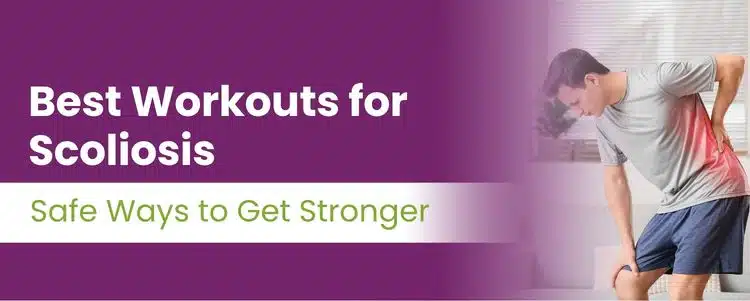
The spine’s design is movement-based, so cultivating a healthy activity level is important for general spinal health, and when scoliosis workouts are customized and scoliosis-specific, they are key elements of nonsurgical treatment.
The best workouts for scoliosis work towards core strengthening, postural awareness and restoration, increasing the spine’s flexibility, pain management, and addressing any muscular imbalance. Scoliosis-specific exercise, as part of a proactive treatment plan, can help correct scoliosis.
Increasing back and abdominal muscles strength and balance means more support and stability for the spine.
Strength and Scoliosis
The spine is integral to the body’s strength, function, and overall health, and scoliosis causes an unhealthy sideways spinal curvature to develop; in addition, the spine also rotates unnaturally.
Scoliosis disrupts the spine’s balance and stability, making it weaker and more vulnerable to strain and injury.
The spine’s healthy curves make it stronger, so an unhealthy curve weakens the spine and exposes it to uneven pressure.
As it’s not just the spine that maintains its alignment, but also the spine’s surrounding muscles that stabilize and support the spine, increasing strength can take pressure off the spine.
A muscular imbalance is a common effect of scoliosis. The condition doesn’t just affect the spine, but also its surroundings, and increasing strength and muscle balance can help stabilize the spine and balance its surroundings for more support.
As an asymmetrical condition, scoliosis can disrupt the body’s overall symmetry; a misaligned spine that’s left unaddressed can throw the entire body off balance, leading to uneven wear and tear on the spine and major joints.
Increasing core stability and strength is a key focus of nonsurgical scoliosis treatment, and knowing which exercises are considered the best for scoliosis can help.
Best Exercises for Scoliosis
No exercise routine should be adopted unless approved by a scoliosis patient’s treatment provider. Just as treatment plans need to be fully customized to address specific scoliosis and patient factors, exercise plans need to be scoliosis-specific and individualized.
The best exercises for scoliosis are safe for the spine and can improve core strength and stability for healthy posture and curve correction.
Most cases of scoliosis require more than just a scoliosis-specific exercise plan and need to be combined with the potential of corrective bracing and scoliosis-specific chiropractic.
Exercises for scoliosis that increase spinal flexibility are also helpful for pain relief and increasing the spine’s responsiveness to treatment; curve flexibility is a key factor when it comes to determining the best course of treatment.
Progression increases the spine’s rigidity, making it more difficult to improve its position, and exercise that helps counteract rigidity can increase the potential for successful treatment outcomes.
Increasing core stability supports healthy posture, and because postural health and spinal health are so connected, improving one always benefits the other.
Exercise recommendations for scoliosis patients are always case specific, but the following exercises are generally considered safe exercises for increasing strength with scoliosis.
Bird-Dog
The Bird-Dog is a simple exercise easily performed without equipment and involves kneeling on the hands and knees while performing alternating arm and leg extensions.
The Bird-Dog helps strengthen and stabilize the core for more spinal mobility and support.
Pelvic Tilt
The pelvic tilt is an ideal exercise for scoliosis patients; it can address the common effect of a muscular imbalance by strengthening the muscles working to counteract the spine’s unnatural curve.
Engaging the core and strengthening lower back muscles can help stabilize the pelvis and lower body: important for balance and a healthy gait.
The pelvic tilt involves lying on the back on a mat with the knees bent, feet flat on the floor, and arms at the sides. The abdominal muscles are tightened to press the lower back into the floor, and the goal is to counteract pelvic obliquity through symmetrical exercise and stabilizing the spine.
Cat-Cow Stretch
The Cat-Cow Stretch can help improve spinal mobility and relieve tension in the thoracic spine and the lumbar spine. Starting on the hands and knees, the back is gently arched upwards and then rounded downwards.
The Cat-Cow can provide pain relief because it’s a gentle repetitive movement that promotes postural awareness and intentional movement through focusing on moving one section of the spine at a time.
The best way to get stronger with scoliosis is through the use of exercise and movement that offers core strengthening for improved stability, and there are also scoliosis-specific exercise approaches that increase strength while offering corrective potential.
Scoliosis-Specific Exercise as Treatment
The place of scoliosis-specific exercise in nonsurgical scoliosis treatment is firmly held, and when combined with additional types of treatment, such as corrective bracing and scoliosis-specific chiropractic care, it can facilitate improvements to the spine’s structural alignment and surrounding muscle strength and balance.
The two main scoliosis-specific rehabilitative exercise approaches include the Schroth Method and SEAS (Scientific Exercise Approach to Scoliosis).
Schroth exercises are widely used and offer a complete 3-dimensional approach to improving scoliosis.
Exercises are highly customized and specialized to target muscular imbalance: strengthening weak muscles on the convex side of the curve while stretching and relaxing tight and overused muscles on the concave side of the curve.
Rotational angular breathing is a key facet of the Schroth method that helps to expand areas of the rib cage that have been affected by postural changes, and the use of Mirror Image exercise helps educate patients on how to position their spines and bodies during movement for optimal spinal alignment and health.
Schroth exercises can be beneficial for patients of all ages and curves of all severity levels.
SEAS focuses on strengthening the neuromuscular system for improved brain-body communication and positioning.
Self-correction is at the heart of SEAS as patients are trained to recognize poor posture and its effects, and the connection is supported through exercise that trains the body and mind to work together to maintain the body and spine’s optimal alignment.
Self-corrected posture becomes the new normal and is supported by stronger core and back muscles for more stability.
Conclusion
As you can see, there are many roads to increasing strength with scoliosis, and the best path involves professional guidance and workouts that offer therapeutic benefits, core strengthening, pain relief, and correction.
General exercises and stretches such as Pelvic Tilts, the Cat-Cow stretch, and the Bird-Dog can help with general improvements to spinal health and mobility, and the The Schroth Method and SEAS can be combined with corrective 3-dimensional bracing and scoliosis-specific chiropractic care to impact scoliosis on every level for true correction.
Here at the Scoliosis Reduction Center®, the power of scoliosis-specific exercise is at the heart of conservative scoliosis treatment, and while exercise alone can’t correct larger more rigid curves, when combined with additional treatment disciplines, there are fewer limitations to what nonsurgical scoliosis treatment can achieve.
Workouts that improve posture, spinal flexibility, mobility, core strength and muscular balance have a lot to offer scoliosis patients.
Getting stronger with scoliosis exercises can make the spine more responsive and a favorable treatment outcome more likely.