

Considering the value of diagnosing and treating childhood scoliosis early, it’s a good idea for all parents and caregivers to have awareness of the early signs to watch for, and because scoliosis appears to run in families, if one child is diagnosed, siblings may share the same genetic predisposition.
If a child in the family has already been diagnosed with scoliosis, the likelihood of another child being diagnosed increases by approximately 30 percent, so it’s highly recommended that siblings be regularly screened, particularly as puberty approaches because growth can trigger childhood curves to progress quickly.
Parents need to understand the importance of awareness and early screening, but we also want to be clear that a genetic predisposition doesn’t guarantee a diagnosis.
Understanding Idiopathic Scoliosis
Scoliosis can develop in children with or without a family history, so it’s always important to have awareness and be on the lookout for warning signs. But if a child has a sibling with scoliosis, early and regular screening from a young age is highly recommended because it’s considered a significant risk factor.
Idiopathic scoliosis is complex, and we don’t fully understand what causes its initial onset, but there are a number of theories, including some that focus on genetic and familial factors.
Approximately 80 percent of scoliosis curves are idiopathic, and there is no single known cause or specific gene that accounts for idiopathic scoliosis onset. It’s generally regarded as multifactorial—caused by a number of factors, or the interplay between certain factors, and may differ from patient to patient.
Genetic and Familial Scoliosis Factors
The general consensus is that the initial onset of adolescent idiopathic scoliosis may be caused by a combination of genes and environmental factors during growth, and keep in mind, families share a lot more than just genes.
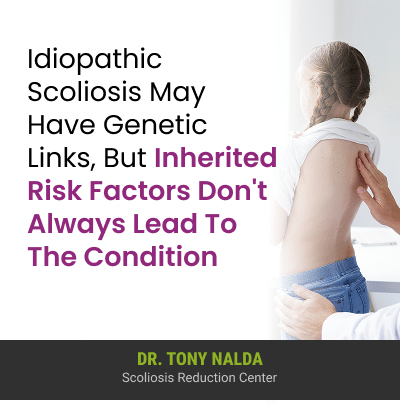
The role of family history can also be understood in terms of shared variables among family members such as body type, diet, lifestyle, posture, and more.
Idiopathic scoliosis may have genetic factors because more than one diagnosis is common in a family, but this isn’t always the case, and although certain genetic markers may increase a child’s risk of a diagnosis, it’s not guaranteed.
The most common type of idiopathic scoliosis overall is adolescent idiopathic scoliosis, and it’s usually assessed as high progression risk due to the peak-velocity growth that happens during puberty, so the timing of detection and treatment matters, particularly in rapidly-growing children.
Why Early Detection Matters
Early detection matters because most scoliosis curves are progressive, and proactive curve management during growth, rather than after, is the key to managing childhood scoliosis in many cases (1). If a child has known risk factors such as a sibling who has been diagnosed, close monitoring is recommended so early signs of scoliosis don’t go unnoticed and valuable treatment time is not missed.
When scoliosis is diagnosed early, it gives patients and families time to process the news, do their own research, and monitor the patient for changes. Most importantly, for curves assessed as progressive and in need of treatment, it supports early intervention.
Growth is a challenge of treating childhood curves because it can contribute to rapid progression, but it also provides an advantage: curve flexibility.
When spines are growing, they are more flexible and may have more corrective potential. Turning growth into an advantage, however, requires timing. The ideal time to start childhood scoliosis treatment in many cases is before significant growth has happened, but while the spine is still growing, flexible, and likely to respond to treatment plans.
Studies support that early curve detection and proactive curve management produces better patient outcomes (1), but it’s not always easy to diagnose scoliosis while mild because its effects can be subtle and difficult to notice. This is where awareness comes into play.
Early Signs of Scoliosis to Watch for in Children
People who spend a lot of time around children can observe them as they grow, and the earliest telltale signs of scoliosis in children are usually postural changes such as uneven shoulders, uneven hips, and one shoulder blade sticking out more than the other. A rib cage arch is also common in cases of thoracic scoliosis because the thoracic spine attaches to the rib cage and can disrupt its balance and position.
And because we understand that having one child with scoliosis increases the likelihood that another will be diagnosed, these parents have awareness and can vigilantly watch other children for signs of scoliosis, along with having them screened regularly by medical professionals.
If a curve is progressing, uneven posture can become more pronounced and disruptive, and how a child walks is commonly affected, along with changes in balance and coordination.
Postural changes don’t guarantee a diagnosis of scoliosis, but they are an indication that further testing may be necessary, and a spine assessment from a medical professional can guide patients and families on whether an X-ray is suitable.
What to Expect During a Scoliosis Screening Examination
Scoliosis screening examinations are appropriate for anyone who suspects they may have scoliosis, has noticed signs in a child, or is concerned about a future diagnosis because of family history.
If you have noticed early postural changes and/or want a child screened due to family history, screening examinations are painless, informative, and necessary to reach a diagnosis and start treatment planning when necessary.
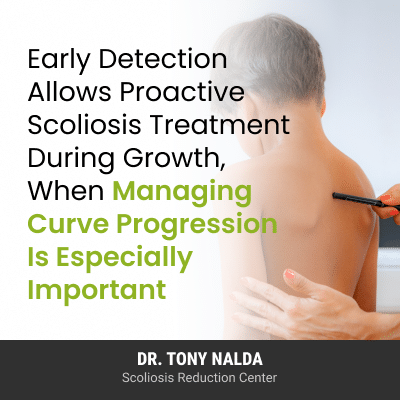
A screening examination should be performed by a scoliosis specialist who has experience recognizing the sometimes subtle warning signs of scoliosis. It usually starts with taking the patient’s medical and family history with a focus on whether or not there are other members in the family with scoliosis. Any symptoms and concerns are also discussed.
I can tell a lot about the health of a patient’s spine by their posture and gait, so I evaluate how a child holds themselves and walks, and an Adam’s forward bend test involves asking patients to bend forward at the hips as if trying to touch their toes, but leaving their arms hanging neutrally at the sides while the back is parallel to the floor.
In this position, the spine is highly visible and so are uneven shoulders, shoulder blades, hips, and the characteristic rib cage arch.
Because scoliosis causes the spine to curve to the side and rotate, a ScolioMeter® is often used as part of an Adam’s test and is a medical device resembling a ruler that’s placed over the spine to assess a patient’s angle of trunk rotation (ATR).
If a screening exam finds indicators of scoliosis, an X-ray is usually the next step and is the only way to confirm the spine’s unnatural curve, rotation, and size.
What a Scoliosis X-ray Tells Us
A scoliosis X-ray is needed to reach a diagnosis of scoliosis and tells us what we need to know about a patient’s curve and situation.
A number of measurements are taken that indicate how severe the curve is, how much rotation there is, how much flexibility there is, curve location, direction, and assessing a young patient’s bone age helps predict future curve progression.
A scoliosis X-ray provides the information needed to personalize care recommendations and craft a treatment plan that supports the spine’s alignment, proper body posture, and the strength to maintain it.
A patient’s scoliosis X-ray requires accuracy and precision because the results are used to craft treatment plans and determine whether scoliosis-specific physical therapy, corrective bracing, chiropractic care, or a combination of treatments is needed for a broader approach.
Some patients with severe curves, highly progressive curves, or curves that haven’t been treated and have been left to progress may be recommended for a surgical consultation.
Conclusion
Scoliosis screening exams are appropriate and recommended in a number of situations, and family history is considered a significant risk factor that warrants regular and early screening in children.
When a child has a sibling with scoliosis, consistent monitoring for changes can involve patients and caregivers regularly checking for signs of uneven posture at home, but nothing can replace a professional evaluation.
Children with a family history should be screened for scoliosis during regular pediatric checkups, and the frequency should increase as puberty approaches because most adolescents are diagnosed during a growth spurt when signs become more noticeable due to progression.
There are no treatment guarantees, but with awareness and regular screening, early detection and intervention support proactive treatment planning and curve management in many cases of childhood scoliosis, and here at the Scoliosis Reduction Center®, patients are thoroughly evaluated for informed care recommendations.
References:
- Negrini, S., Donzelli, S., Aulisa, A. G., Czaprowski, D., Schreiber, S., de Mauroy, J. C., … & Zaina, F. (2018). 2016 SOSORT guidelines: orthopaedic and rehabilitation treatment of idiopathic scoliosis during growth. Scoliosis and spinal disorders, 13(1), 3