

Congenital scoliosis and infantile scoliosis are rare. Congenital scoliosis is caused by a malformed spine that develops in utero, and infantile scoliosis curves are idiopathic, meaning no known cause. Because congenital scoliosis involves structural abnormalities within the spine, it’s likely to get worse with growth, while some cases of infantile scoliosis resolve on their own.
Scoliosis is most often diagnosed during adolescence, but it affects all ages, including infants. The difference between congenital scoliosis and infantile scoliosis is that babies are born with congenital scoliosis; infantile scoliosis is idiopathic and refers to scoliosis in children between 6 months and 3 years old.
Both congenital scoliosis and infantile scoliosis are rare forms, but have some important distinctions.
Congenital Scoliosis
The spine’s health shapes our ability to engage in flexible pain-free movement and practice good posture; it’s also key to nerve health, organ protection, and is the body’s central structural anchor.
Spinal health is shaped by a number of internal and external factors. The spine’s vertebrae (bones) need to be rectangular in shape so they can maintain the spine’s alignment, its discs need to stay hydrated and healthy, facet joints need to be strong to connect vertebrae and enable smooth movement, and the spine also needs to be supported by healthy surrounding muscles.
A number of checks and balances are in place to maintain spinal health and function, but it all starts with how the spine forms during gestation.
Congenital scoliosis occurs when the spine is malformed in utero so is present at birth. Congenital scoliosis is a rare type affecting approximately 1 in 10,000 babies.
The spine’s formation during gestation occurs in stages. The process starts around weeks 3 to 4 with the formation of the neural tube, which will later become the brain and spinal cord. Cells that will eventually form the spine’s vertebrae (bones) and muscles of the back cluster around the tube. During weeks 6 to 8, bone hardening begins (ossification) that will form the spine’s bony structures. From week 9 to full term, the vertebral column and spinal cord are growing rapidly.
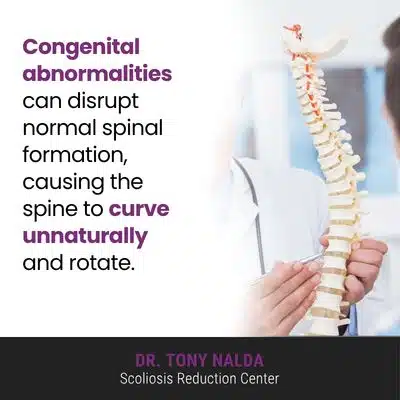
If the process of the spine’s formation is interrupted by irregular vertebral growth and/or the failure of vertebral bodies to separate, these congenital abnormalities can disrupt the spine’s ability to form in a straight and neutral alignment, instead causing it to curve unnaturally to the side and rotate.
Children with congenital scoliosis need to be comprehensively assessed because they often present with additional congenital abnormalities: lung, heart, and kidney problems are common.
Signs and Symptoms of Congenital Scoliosis
The most noticeable sign and symptom of congenital scoliosis is physical deformity. Scoliosis introduces a lot of uneven forces to the spine and body, and as an asymmetrical condition, it disrupts the body’s overall symmetry and alignment.
Uneven shoulders, uneven hips (one hip appearing higher), one shoulder blade sticking out excessively, a rib hump, and clothing not fitting properly are common signs.
Pain isn’t a common symptom due to the spine’s lengthening motion during growth counteracting the curve’s compressive force.
Congenital Scoliosis Treatment Options
In many cases of congenital scoliosis, the condition becomes more noticeable with growth, and progression with growth needs to be managed proactively; babies have a significant amount of growth to go through, and the main trigger for scoliosis progression is growth.
Curve severity is a determining factor in the customization of treatment plans and depends largely on the type and severity of the vertebral bone defects.
Because congenital scoliosis curves are caused by structural deformity, treatment plans need to impact the structural issues within the spine to prevent further progression, and with severe curves, some patients with congenital scoliosis may require surgical treatment.
Infantile Scoliosis
Infantile scoliosis develops a little later, commonly around 6 months old and up to 3 years. Unlike congenital scoliosis that’s caused by malformations in the spine, the cause of infantile scoliosis is idiopathic.
Most scoliosis cases are idiopathic, meaning not clearly associated with a single-known cause, and infantile scoliosis is rare, accounting for approximately 1 percent of idiopathic scoliosis prevalence.
Scoliosis ranges widely from mild to very severe, and some mild idiopathic curves in infants resolve on their own, while others can progress with growth, and there is no way of knowing which cases will resolve without treatment and which will increase in severity over time and require a comprehensive treatment plan.
Managing curve progression requires proactive treatment, so early detection and intervention are key.
Signs and Symptoms of Infantile Scoliosis

Like congenital scoliosis, the main effects of infantile scoliosis involve asymmetrical postural changes; uneven shoulder height and hips are common, along with rib flaring, a noticeable favoring of one hip, and leg length discrepancy.
Also like congenital scoliosis, pain isn’t a common symptom of infantile scoliosis.
A large number of mild infantile scoliosis curves resolve on their own, whereas congenital scoliosis can’t resolve on its own due to the spine’s structural issues.
In cases that resolve, the spine straightens out with growth, rather than progressive curves becoming more unnaturally curved and twisted with growth.
Infantile Scoliosis Treatment Options
Treatment recommendations are always case-specific but commonly involve observation, casting, bracing, or surgical treatment for severe curves that are progressing with growth.
In cases of severe childhood scoliosis progressing rapidly with growth, spinal fusion surgery may be recommended, but this is often delayed until as much growth as possible is complete because it’s an invasive surgical procedure that limits movement and growth in the spine’s fused portion.
Surgical intervention for idiopathic scoliosis in young children has a lot of future growth to account for so may employ the use of growing rods or vertebral body tethering, but because of the unique challenges of treating progressive scoliosis in children under 3, Mehta casting or bracing are common first line treatment responses.
An abnormal sideways curvature of the spine needs to be addressed; if a progressive curve is left untreated, it can cause complications that affect organ systems, can cause breathing problems, rib cage deformity, and a variety of health problems.
Once a child reaches skeletal maturity, progression tends to slow down, but during growth, congenital and infantile scoliosis can progress quickly.
Conclusion
Scoliosis cases vary widely in severity and treatment needs, but one commonality every severity level and type of scoliosis shares is the higher potential for correction with early intervention.
However, the potential benefits of early intervention are only within reach when early detection occurs. Diagnosing scoliosis early means treatment can be started early, and awareness of the early signs of scoliosis in infants is key.
Congenital scoliosis and infantile scoliosis share a number of common characteristics, but also some key differences.
Congenital scoliosis is caused by structural abnormalities that occur as the spine is forming and growing in utero. If vertebrae are misshapen, it can disrupt their ability to stay aligned, or if they fail to separate into distinct and separate vertebrae, a sharp wedge-shape in the vertebrae can develop that causes the spine to curve and rotate unnaturally.
Infantile scoliosis develops between 6 months and 3 years old and involves an idiopathic curve, not a congenital curve.
Infantile scoliosis has unknown causes, but mild curves can resolve on their own, and progressive curves will increase with growth, becoming more disruptive over time.
Treatment options for congenital scoliosis include monitoring, bracing, casting, and sometimes surgical options are necessary. Progressive idiopathic curves require early intervention with bracing, casting, and severe cases may require spinal surgery with growing rods to account for continued growth, but surgical treatment may be delayed due to challenge of growth.