
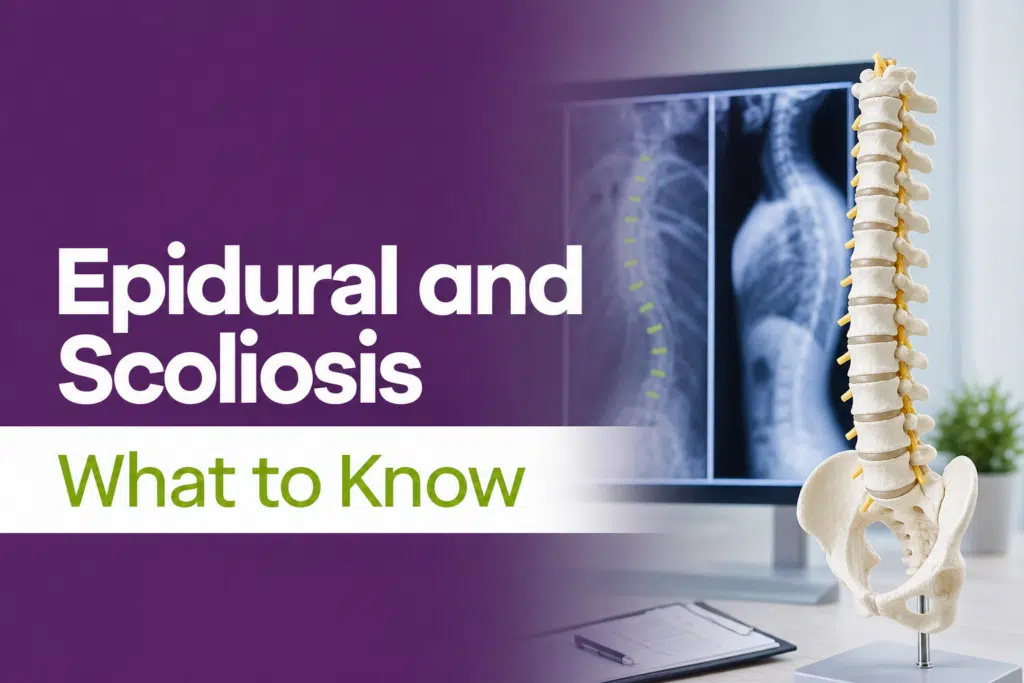
Scoliosis is associated with a number of effects, and as a progressive condition, scoliosis symptoms can become more severe and disruptive over time. A particular area of interest for females is how scoliosis may affect pregnancy, the ability to get pregnant, and/or the delivery.
Scoliosis develops in the spine, not the pelvic region, so it’s not closely associated with pregnancy issues. Scoliosis also isn’t known to make it harder to get pregnant, nor is it associated with difficult pregnancies and/or complications during delivery. If a current X-ray is provided, epidural placement can be precise and effective.
An area some pregnant women with scoliosis may find challenging is back pain, but this can also be said of pregnant women without scoliosis.
Epidural
Epidurals are used primarily during labor and delivery to numb a woman’s pelvic region and lower body for pain relief.
An epidural is a regional anesthetic that’s infected into the space around the spinal cord, known as the epidural space, in the lumbar spine, to block pain signals from the spinal roots where they exit the spine.
Epidurals are most frequently used in labor and delivery, but can also be used for treating chronic pain.
When effective, an epidural can numb the lower body for pain relief, while allowing the patient to stay awake.
The procedure involves a thin catheter (tube) being placed in the epidural space around the spinal canal, and this allows for medication to be continuously delivered for consistent pain relief.
It’s estimated that appropriately 70 percent of women have an epidural during labor and can be used both for vaginal deliveries and C-sections.
As long as the catheter is kept in place, pain-numbing medication can be delivered throughout labor, and after, if needed.
So we know the benefits of getting an epidural can include pain-free delivery, being able to stay awake, and rest during long labors.
Epidural and Scoliosis
Scoliosis patients may have a lot of concerns about the ability to get pregnant, carry a healthy pregnancy to term, and/or deliver without complications.
Scoliosis patients have similar fertility rates with successful labor and deliveries as women without scoliosis, and when it comes to the epidural, a current X-ray is needed to visualize the spine so the anesthesiologist can deliver the catheter precisely into the epidural space around the spinal cord.
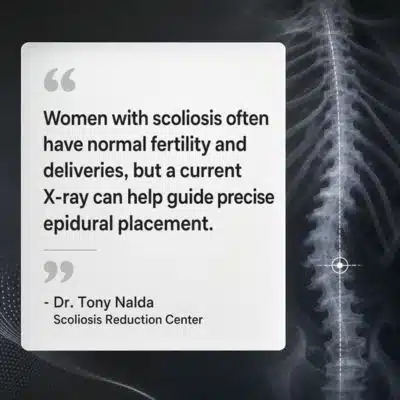
Because scoliosis causes the spine to curve unnaturally to the side and rotate, its misalignment needs to be taken into account for optimal epidural placement and results.
In addition, patients who have been treated for their scoliosis with spinal fusion surgery also have to provide a current X-ray so the spine’s position is known, and hardware doesn’t interfere.
Other than the necessary caution of confirming the spine’s position for epidural placement, there is no significant difference in epidural effectiveness or outcome.
So not that we know epidurals can be safe and effective for scoliosis patients, let’s talk about back pain.
Back Pain, Pregnancy, and Scoliosis
When it comes to being pregnant with scoliosis, back pain can increase due to the extra weight and pressure on the spine, but it’s also important to understand that most adult scoliosis patients, whether pregnant or not, will experience scoliosis-related back pain.
The best way to achieve pain relief is to treat scoliosis proactively. The more severe a patient’s scoliosis, the more likely it is to be painful, and scoliosis pain can involve the back, the spine’s surrounding muscles, and radiating pain due to nerve compression.
Particularly with lumbar scoliosis, pregnant women may experience an increase in lower back pain, as the lower spine is curved and rotates unnaturally, and adding the extra strain of pregnancy and increasing weight on the lower back can be painful.
Even without scoliosis and/or pregnancy, the lower spine is the most vulnerable to pain, strain, and injury, and most pregnant women without scoliosis will still experience lower back pain.
So will pregnancy increase scoliosis pain? Possible, but not necessarily, and of course, in cases where back pain does increase, it can be difficult to determine whether it is due to the pregnancy affecting the scoliosis, or vice versa.
Scoliosis isn’t associated with difficult pregnancies or difficulty getting pregnant, nor is it associated with an inability to carry full term, but what happens during labor and delivery?
Labor, Delivery, and Scoliosis
Scoliosis isn’t associated with an inability to carry babies to term, nor is it associated with labor and delivery complications.
In most cases, patients can develop full-term babies vaginally and safely, and recommendations for C-sections mainly involve obstetric reasons, not caused by the scoliosis.
So the most important thing to know about scoliosis, pregnancy, labor, and delivery is that fertility and the ability to get pregnant isn’t impacted by scoliosis. When it comes to the pregnancy, scoliosis also isn’t known to complicate pregnancies or cause pre-term labor.
While some women may experience increasing back pain, whether this is a direct result of the scoliosis or the pregnancy is difficult to determine.
Scoliosis patients can carry babies full term for a safe vaginal delivery, and when it comes to recovery, there are no significant differences between women with and without scoliosis.
The labor-recovery period can differ from patient to patient, and when it comes to scoliosis patients, it’s important to return to exercise and core strengthening as soon as possible.
The best way to minimize the potential effects and complications of scoliosis is with a proactive treatment plan.
And for women who are experiencing increasing back pain after pregnancy and labor, it’s important that a postpartum scoliosis-specific exercise plan helps restore the spine’s alignment, stability, balance, and strength.
It’s important to maintain a strong core for spinal support, but also in preparation for carrying an infant around.
Strong abdominal muscles are also key to healthy posture; the strain of nursing and carrying an infant, and scoliosis, can cause the development of unhealthy posture and movement patterns, so returning to a healthy posture and mindful movement is important during the recovery period.
Returning to scoliosis treatment will be recommended for as soon as possible, likely within 6 weeks, following delivery.
In preparation for labor, the body’s joints, ligaments and supportive structures soften and loosen to facilitate the birth due to the hormone relaxin that’s regularly released during pregnancy.
Relaxin mainly prepares the pelvic area for childbirth by increasing its flexibility, but this can also contribute to instability, so following labor, efforts should be made to restore a scoliosis patient’s stability to prevent injury and/or curve progression.
Conclusion
What you need to know about getting an epidural with scoliosis is that it can be safe and effective. Primarily used to numb the pelvic area and lower body to block pain signals, women can deliver their babies without pain and have opportunities to rest during long labors.
For women with scoliosis, getting an epidural is common, and the only potential risks involve the precise placement of the epidural needle into the epidural space. If the spine curves and twists unnaturally, it’s atypical so an anesthesiologist needs to see a current X-ray image of the spine to ensure optimal epidural placement.
For patients who have had their scoliosis treated with spinal fusion surgery, caution is also needed to avoid the hardware and ensure the epidural space is reached.
While scoliosis can cause a number of unexpected effects, it’s not associated with fertility issues, complicated pregnancies, premature birth weight, and/or difficult labors and recovery periods.
Scoliosis patients can deliver vaginally with or without an epidural as is the case with most women, whether they have scoliosis or not.
It’s important for scoliosis patients to stay active throughout their pregnancy, and professional guidance from a patient’s scoliosis treatment provider can involve customizing an ideal scoliosis-specific exercise plan that’s low-impact while maintaining core strength, balance, and stability.
Staying active throughout a pregnancy is known to improve the recovery period, and in most cases, it’s recommended that scoliosis treatment resumes as soon after delivery as is deemed safe.
Here at the Scoliosis Reduction Center®, I’ve treated a number of pregnant women from an initial diagnosis to active treatment, to adjusting treatment during pregnancy, and safely returning to treatment following delivery.
While no treatment outcome can ever be guaranteed, with monitoring and proactive care, pregnant scoliosis patients may enjoy their pregnancy and safely deliver full-term babies without complications.