
Severe scoliosis can have a number of effects and potential complications, particularly if left untreated. Some patients with severe scoliosis have pulmonary compromise, making it difficult to correct, and halo traction allows for 3-dimensional correction that’s gradual and sustainable.
Halo-gravity traction for scoliosis is a pre-operative treatment for severe childhood scoliosis that can temporarily decrease curve size by elongating the spine. Halo traction involves the use of a device attached to the head that gently stretches the spine, prior to surgical treatment, with the goal of improving surgical outcomes.
Scoliosis ranges widely from mild to moderate and severe to very severe scoliosis, and the more severe scoliosis becomes, the more complex it is to treat.
Severe Scoliosis
When scoliosis is first diagnosed, it’s comprehensively assessed and further classified based on patient age, scoliosis type, location, and severity.
Scoliosis causes an unnatural sideways-bending spinal curve that rotates, making scoliosis a 3-dimensional spinal condition, and treatment needs to address it as such.
As the spine is the body’s main central structural support facilitating proper posture, healthy movement patterns, and nerve health, its alignment is important, and scoliosis causes the spine to become misaligned; if the spine is off-balance, the entire body’s symmetry may be disrupted.
Scoliosis can be diagnosed as mild scoliosis, moderate, severe, or very severe, and severity is based largely on curve size.
Cobb Angle Measurement
A measurement known as Cobb angle expresses curve size in degrees, and the larger a patient’s Cobb angle, the more severe the scoliosis, and the more comprehensive treatment needs are.
In addition to a patient’s Cobb angle, the location of the scoliosis, patient age, and the angle of rotation (ATR) also shape condition severity.
Curves that develop in the thoracic spine, the largest spinal section, are the most prone to rapid advancement, and because growth triggers progression, young patients are more at risk for rapid progression, and the more unnatural rotation there is in the spine, the more correction is needed.
Severe Scoliosis Symptoms
Severe scoliosis symptoms are noticeable; in children, the main symptoms involve postural changes such as uneven shoulders, hips, rib flaring, and a prominent lean to one side, and in adults, pain and instability are usually the most noticeable symptoms of severe scoliosis.
Changes to posture and gait are common in patients of all ages, and muscular imbalance is also common.
When treating severe scoliosis in children, a major risk is rapid curve progression, and for optimal future spinal health and function, a goal of treatment is to preserve as much of the spine’s natural strength and flexibility as possible.
So children who have been recommended for spinal fusion surgery may benefit from a pre-operative adjunct treatment associated with positive surgical outcomes: halo-gravity traction for scoliosis.
There are no treatment guarantees, but scoliosis can be highly treatable; when left untreated, however, curve progression can continue and cause complications such as breathing problems, cardiac and digestive issues.
Scoliosis Treatment Options
There are different treatment options for scoliosis, particularly with early detection, but in severe cases, significant progression has already occurred, and progression causes the spine to become more rigid, painful, and less responsive to treatment; the goal of proactive treatment is to diagnose and treat scoliosis early, while still mild, flexible, and highly responsive.
With early detection and intervention, a scoliosis-specific exercise plan paired with corrective bracing and complementary scoliosis-specific chiropractic care may correct scoliosis and prevent the need for invasive future surgical treatment.
But in severe and/or atypical cases, or scoliosis left untreated for years, the curve is rigid and may require surgical intervention, and in these cases, patients can be funneled towards spinal fusion surgery.
In some cases, a pre-operative treatment known as halo-traction may be recommended to prepare the spine for surgery and reduce severity as much as possible so less surgical correction is needed.
Halo Traction for Scoliosis
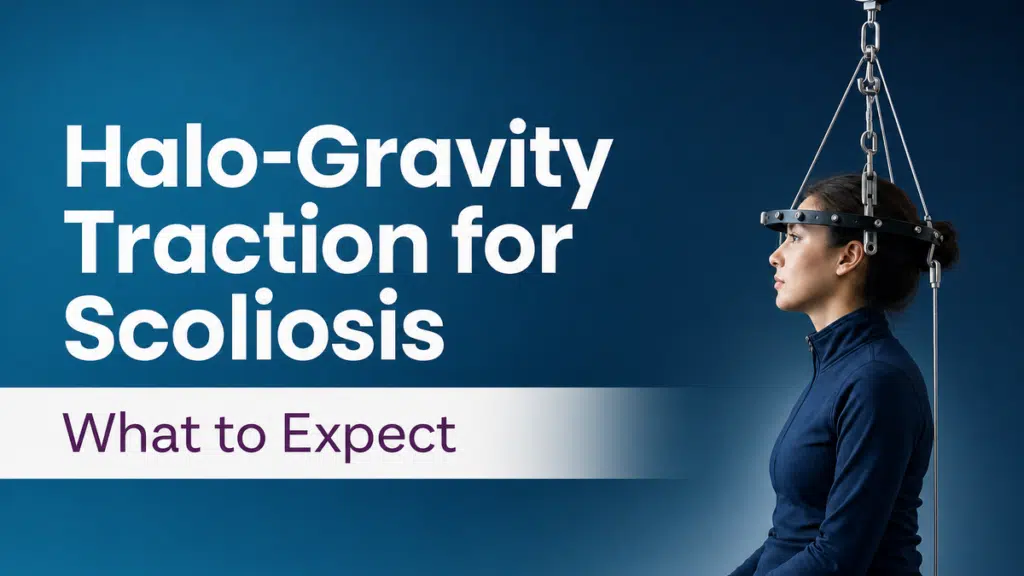
What patients can expect from the procedure of halo traction for scoliosis is a metal ring attached to the head and connected to a pulley system so the spine can be gently stretched and elongated during an intense and continuous process.
Duration of treatment will vary patient to patient; wearing recommendations can range from remaining in traction for 2 weeks, up to 12 weeks. Typical cases average 4 to 6 weeks in the device.
The pulley system can be used while patients are sitting in a wheelchair or lying in bed, and weight is gradually increased based on the patient’s response and efficacy.
Careful monitoring of the curve will involve regular neurological checks and X-rays.
Halo-Gravity Traction and Spinal Fusion Surgery
Spinal fusion surgery is invasive and comes with its share of risks; the procedure commonly involves removing the intervertebral discs that sit between adjacent vertebral bodies and fusing the vertebrae at the curve’s apex into one solid bone; this is done so the vertebrae can’t become more unnaturally tilted over time (progression).
So the goal of spinal fusion surgery is to stop progression through immobilizing the most unnaturally-tilted spinal segment. and in most cases, metal rods are attached to the spine with pedicle screws to maintain the spine’s alignment.
Once a spine is fused, it’s fused for life. Hardware is permanent. If hardware fails at any point, or if there is an adverse reaction, more surgery is needed, and risks increase with each subsequent procedure, so the goal is to minimize the risks of an impending surgery with halo traction for scoliosis.
Halo gravity traction (HGT) is used to address scoliosis in the pediatric population by improving spinal flexibility, pulmonary function, and nutritional status prior to the procedure.
Preoperative HGT is a surgical adjunct that gradually elongates the spine to increase surgical efficacy and reduce the risk of neurological complications.
HGT uses principles of skeletal traction and gravity-assisted countertraction to apply gently stretching pressure to the spine to elongate it, open up space within the spine, and decompress the spine and its surroundings; this can facilitate a partial correction of the curve so spinal fusion doesn’t have to be as invasive.
When it comes to spinal fusion recovery, if the curve is smaller and more flexible at the time of the procedure, less vertebral bodies need to be fused, and lengthier recoveries and adverse effects are associated with larger fusions that involve more vertebrae bodies and larger segments of the spine being immobilized.
The spine’s natural design is movement-based, so fusing the spine can cause a reduced range of motion and flexibility that can impact quality of life.
Halo traction can reduce the number of vertebrae being fused, preserving more of the spine’s natural strength and flexibility.
Conclusion
Regular halo-gravity traction leading up to spinal fusion can increase the spine’s flexibility and reduce the deformity so less of a correction is needed and fewer vertebral bodies need to be fused. In children whose spines are more flexible than adults, flexibility is a key factor in curve-correction potential.
Increasing the spine’s flexibility prior to spinal fusion may also increase the flexibility and range of motion patients are left with post-fusion, along with an easier recovery period.
Here at the Scoliosis Reduction Center®, the treatment approach is nonsurgical and proactive; the goal is to help patients avoid progression, increasing symptoms, and the need for surgical intervention.
There are never treatment guarantees, but when scoliosis is diagnosed and treated while mild, there are fewer limitations to what nonsurgical treatment can achieve, and spinal fusion surgery, while sometimes necessary, can negatively impact the spine’s long-term health.
When treatment plans are customized to address the specifics of a patient’s scoliosis, and the power of scoliosis-specific exercise, corrective bracing, and chiropractic care are combined, scoliosis can be highly responsive to noninvasive conservative treatment options.