
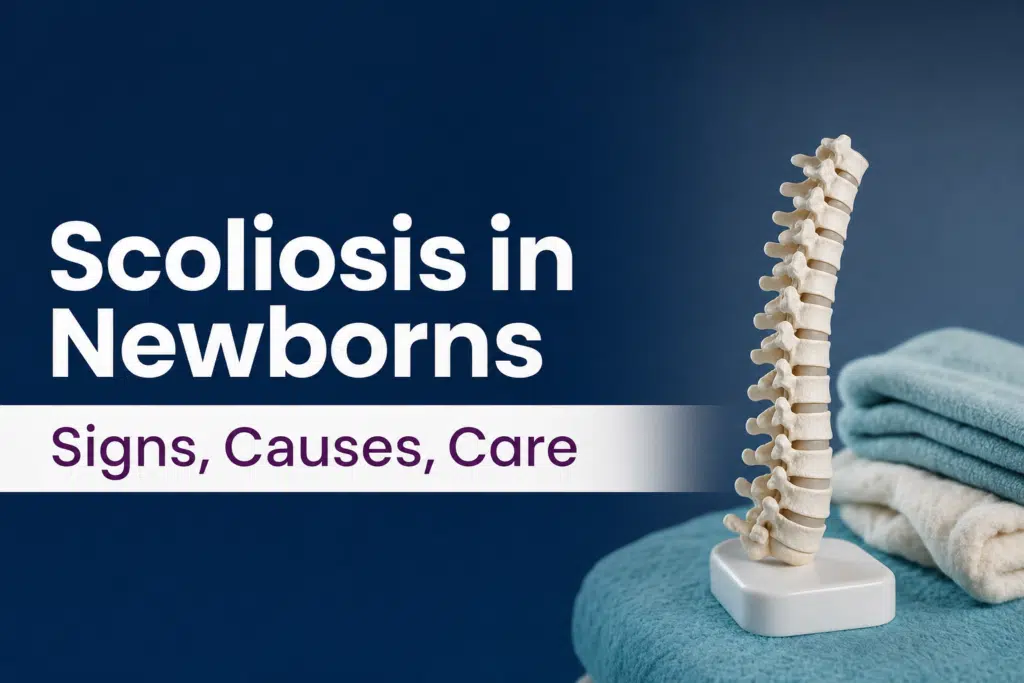
In the first 4-6 weeks of gestation, the spine forms, and if there are issues with how certain vertebral bodies form /or separate, scoliosis can develop. Early signs include asymmetrical posture such as uneven shoulders and hips. Comprehensive assessment and observation is needed.
Scoliosis can affect all ages, including newborns who develop scoliosis in utero. Scoliosis in newborns is diagnosed as congenital scoliosis; it’s a rare form affecting approximately 1 in 10,000 babies. Malformed vertebrae can cause an unnatural sideways spinal curvature with rotation.
Scoliosis is a complex spinal condition with different severity levels and causes.
Congenital Scoliosis Causes
While most cases of scoliosis involve idiopathic scoliosis with no single-known cause, congenital scoliosis is a rare type caused by abnormal spinal bone formation while in utero, so babies are born with the condition.
Babies born with congenital scoliosis need to be comprehensively assessed; it’s common for additional congenital abnormalities to be common involving the spinal cord, kidneys, and heart.
Scoliosis is progressive, and in children, progression is triggered by growth. If congenital scoliosis is missed during pregnancy and/or routine newborn examinations, it can become more obvious as the baby grows.
The spine consists of separate vertebral bodies (bones) stacked on top of one another and separated by an intervertebral disc, and in order for the spine to develop optimally, its vertebrae need to be aligned for a balanced and healthy spine.
If bones are malformed, or fail to separate into distinct vertebral bodies, an unnatural spinal curve can develop.
Common malformations can involve the failure of vertebrae to separate, instead becoming fused into one solid bone, causing the spine to wedge forward unnaturally.
In addition, if certain vertebral bodies are more triangular in shape, versus healthy rectangular-shaped vertebrae, they can disrupt the spine’s ability to form in a straight and neutral alignment.
Congenital Spinal Malformations
A healthy spine is needed for proper posture, healthy movement patterns, strength, flexibility, range of motion, organ protection, and nerve health, and the spine’s overall health is shaped by the natural and healthy curve in each of the spine;s main sections.
The spine’s healthy curves work together to maintain its balance and stability, and as the body’s central structural support anchor, the body’s alignment can also be disrupted by an unnatural spinal curve.
If the spine doesn’t form in a proper alignment, this can involve a hemivertebrae, an unsegmented bar, or a combination of abnormalities.
A hemivertebrae involves one side of a vertebral body not fully forming, and this causes the bone to be more wedge-shaped on the abnormal side, and the malformation causes the spine to tilt unnaturally, rather than growing into a straight alignment.
An unsegmented bar occurs when vertebrae don’t separate, instead forming a fused bridge of solid bone that stops growth on one side while the other side continues to grow, and the uneven growth can cause a severe unnatural spinal curve.
These abnormalities can occur separately or together, and when a hemivertebra on one side of the spine is paired with a bony bar on the opposite side, these curves can be very severe and progress quickly.
Congenital Scoliosis Symptoms
Symptoms of congenital scoliosis include postural asymmetries such as uneven shoulders, tilted hips, rib flaring, and/or a visible unnatural spinal curve.
Most cases of scoliosis are progressive, and while some cases of infantile idiopathic scoliosis resolve on their own, because congenital scoliosis is caused by structural abnormalities within the spine, it’s more likely to become more noticeable with growth.
Scoliosis is progressive, and growth triggers progression, so in many cases of congenital scoliosis, close monitoring is recommended throughout growth to see how the spine is responding.
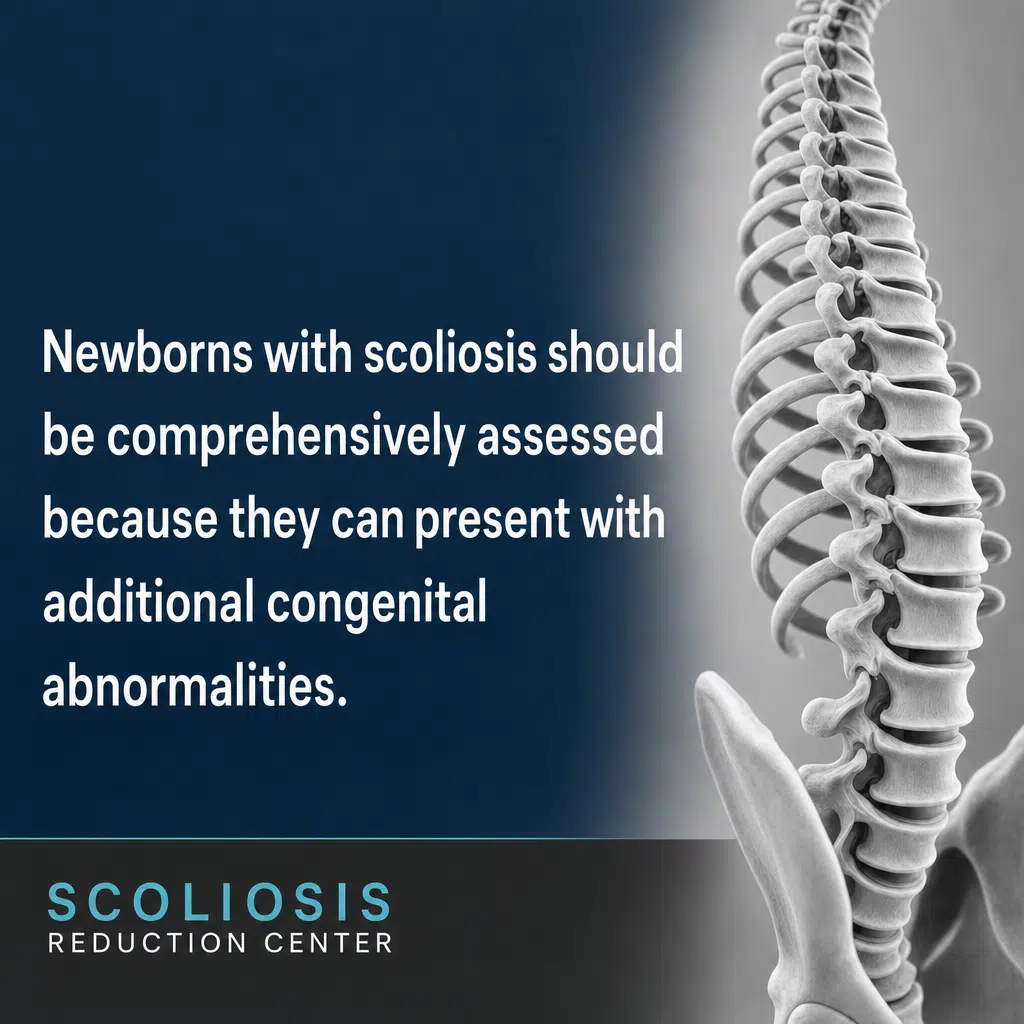
Newborns with scoliosis should be comprehensively assessed because they can present with additional congenital abnormalities.
Congenital Scoliosis Treatment Options
Congenital scoliosis can be detected during routine ultrasounds during pregnancy, but in most cases, it’s X-rays that allow for spinal visualization and diagnose scoliosis. CT scans and MRI imaging may also be used to view specific vertebrae with bony abnormalities and to check for related issues.
X-ray imaging can also determine the size of the scoliosis based on a measurement known as Cobb angle.
If a curve is mild, observation is often the first line of treatment, and for moderate and severe curves, treatment can include casting or bracing treatment. In very severe cases, or cases that are progressing rapidly, surgical options may be recommended.
Scoliosis treatment needs to be customized; no two cases of scoliosis are the same, and the first step to designing treatment plans accordingly is determining a condition’s underlying cause so it can be addressed.
While congenital scoliosis is caused by bony abnormalities in the spine developing while in utero, scoliosis can also develop in infants with no known cause.
Infantile Idiopathic Scoliosis
Newborns are born with congenital scoliosis, and infantile idiopathic scoliosis develops around the age of 6 months up to 3 years.
Idiopathic means no single-known cause, so a malformed spine is not the cause. While some cases of infantile idiopathic scoliosis resolve on their own, others will progress with growth, and there is no way of knowing which are which, so being proactive with treatment is key.
While infantile scoliosis refers to scoliosis developing between the ages of 6 months and 3 years of age, juvenile scoliosis affects children between the ages of 3 and 10 years old.
Congenital scoliosis and infantile idiopathic scoliosis are considered rare types, and the most common form of scoliosis is adolescent idiopathic scoliosis diagnosed between the ages of 10 and 18.
Adolescent Idiopathic Scoliosis
Adolescent scoliosis is the most common type and because of the rapid phase of growth that occurs during puberty, it’s the most prone to rapid progression.
Compared to younger children, adolescents are growing rapidly, so most cases of adolescent idiopathic scoliosis are progressive, and how scoliosis is managed during growth can shape the spine’s long-term health.
Adolescents need to be treated proactively to prevent scoliosis from progressing into adulthood, when scoliosis becomes compressive and more complex to treat.
The two main types of scoliosis to affect adults include adolescent scoliosis in adults (ASA) and degenerative scoliosis that develops later in life.
If adolescent idiopathic scoliosis is diagnosed and treated proactively during adolescence, it may be correctable while the spine is still growing and flexible.
Conclusion
Cases of congenital scoliosis are rare, affecting approximately 1 in 10,000 babies. Congenital scoliosis is caused by spinal malformations that develop in utero. If one or more vertebrae are misshapen, scoliosis can develop, and if vertebral bodies fail to separate, instead fusing together as one solid bone, the spine’s ability to form in a straight alignment can also be disrupted.
While some cases of congenital scoliosis can be predicted prior to birth based on routine ultrasound results during pregnancy, most cases are diagnosed during routine newborn examinations; however, mild cases can be difficult to diagnose, until growth spurts trigger progression and make the scoliosis more noticeable. Some cases of congenital scoliosis aren’t diagnosed until as late as 2 years of age.
Scoliosis treatment plans need to be modified to address the unique challenges of treating such young patients.
After assessment, observation, and bracing treatment, the next line of congenital scoliosis treatment is often surgical intervention for severe cases.
Early detection is always beneficial if followed by early intervention, so knowing the early signs of scoliosis in newborns and children to watch for can help with early detection.